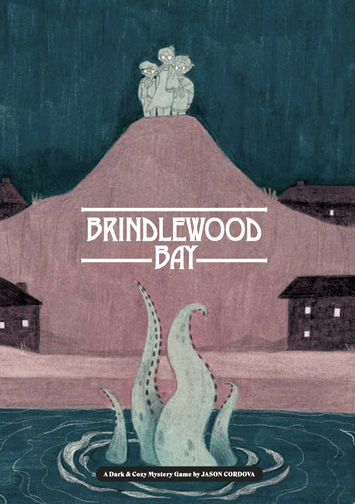
Last year, a friend introduced our group to Brindlewood Bay. I was immediately struck by its near-perfect mystery system. Over six sessions, we told a largely player-driven, truly resonant story about facing loss. Now, I’m running Public Access for some of the same group. Three sessions into a planned year of play, having seen the mechanics from both sides of the screen, I have thoughts.

As a player, it took a moment to grasp the game’s open use of modular clues. The designer makes no attempt to retroactively make the clues “real”—that’s the players’ job. They solve the mystery by being good storytellers with the provided prompts.
For example, if my character finds “a series of numbers,” asking “What are the numbers?” is the wrong approach. The numbers mean nothing on their own; they need context.
As a Game Master, this wasn’t a novel concept. I’ve been a fan of Sly Flourish’s The Eight Steps of the Lazy DM since I started the hobby. It boils down to keeping prep modular so you can be flexible and responsive. The eight steps are the raw ingredients you bring to cook with, but the cooking happens at the table.
One essential ingredient I always use is secrets and clues: modular facts about the situation, plot, characters, or setting. I don’t plan how the players will discover them, but I’m ready to dish out information when they investigate.
The major difference between running D&D with secrets and clues versus running Public Access is that, with the latter, even I don’t know what’s going on—I’m just dishing out the clues.
I have finally found a game so well-designed I can barely prep for it.

I was surprised yesterday to hear Sly Flourish on the Lazy RPG Talk Show critique the Daggerheart adventure, The Wish Thief, and get tripped up on this mystery mechanic.
“I don’t know what clues to reveal if I don’t know who it is,” he said. “The secret and clue is still a specific thing that leads a specific way.”
I’ve never used secrets and clues that way; I’ve always improvised to align with the players’ interpretations. I thought that was how they worked!
While Daggerheart isn’t for me, I was impressed the new adventure used this mechanic, though I agree it fumbles the outcome. In the Wish Thief, whether the players solve the mystery or not, the villain escapes to trigger a chase scene. Mike rightly criticizes this railroading, but culminating a mystery in a tense scene dependent on the players’ success is a great concept.
In Brindlewood Bay, players roll to test their theory. Depending on the roll and the depth of their investigation, they may have a chance to stop the villain. If they didn’t find many clues and roll a mid-tier result, the villain slipping away makes sense. Cue the chase. This feels much better, ensuring the players’ choices and efforts actually matter.


Leave a Reply