Yesterday I released a new adventure as part of the LIMINAL HORROR SUMMER JAM 2026 hosted by the games’ developers. You can download Dead Town Louisiana for free right here.
I thought it could be worthwhile to go over each of the spreads and share a bit about my design intent, and share some commentary or secrets that never made it to the page for the final product.
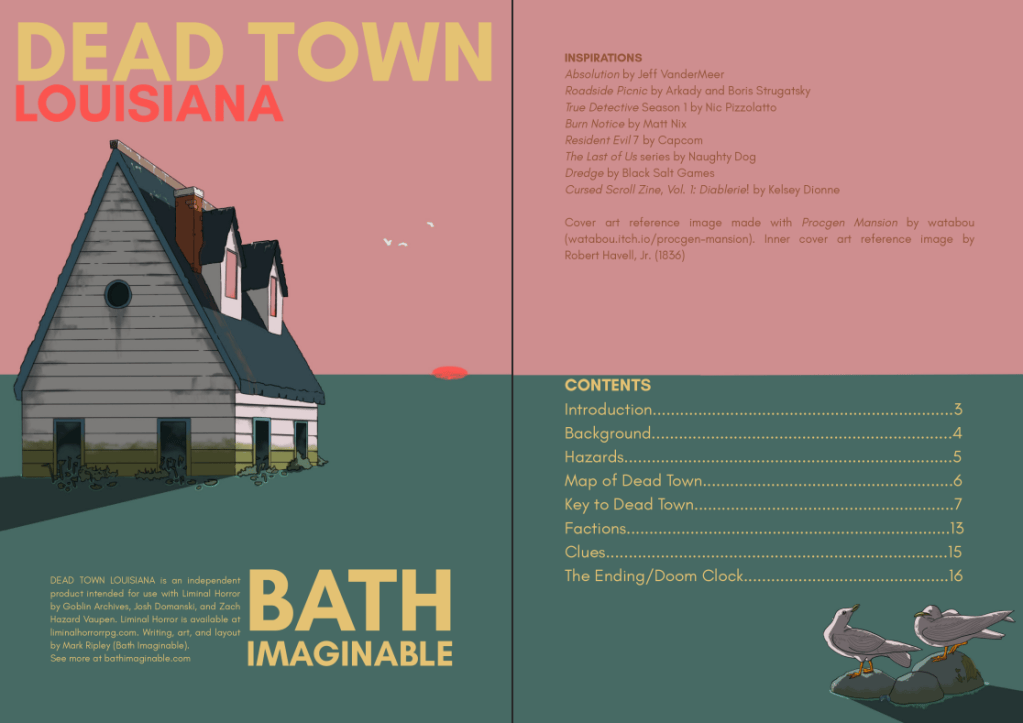
The cover art and inner cover appeared in my mind’s eye fully formed: a sunset over a flooded home, facing away from Dead Town toward the gulf. I briefly considered thick, fluffy clouds catching red sunlight, but preferred the flat water and sky. It makes the subjects look trapped in an endless, digital void.
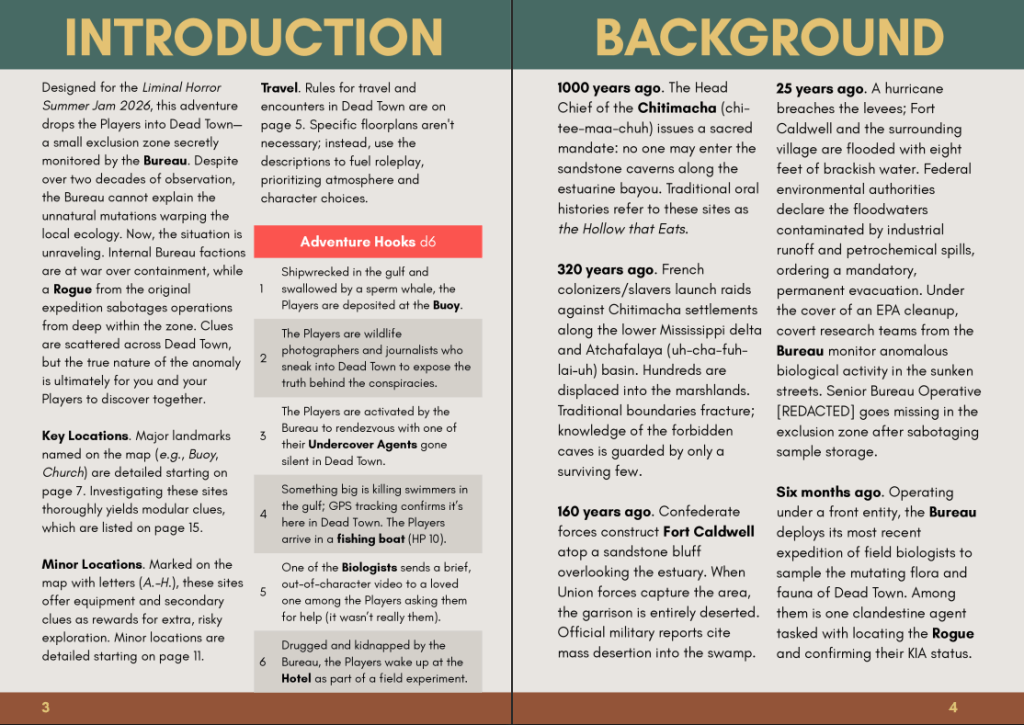
Here are the first and last page I wrote, side by side. I wanted to write down the background before doing anything. Some really useful resources for that: the Chitimacha Wikipedia article, chitimacha.gov, and National Geographic Kids (yes, Kids–I liked the pictures).
This is the first thing I’ve written set in “the real world,” so even though it’s a bunch of VanderMeer nonsense and a True Detective pastiche, I wanted the setting to feel plausible. Plausible was the goal, because I’m not going to let realism get in the way of a good time at the table.
I wrote the introduction last because I didn’t know the adventure’s focus until the rest was finished. Honestly, I struggled with adventure hooks. When using pre-written adventures, I almost always toss out the provided hooks for my own. For example, I plan to run the Hounds of Hendenburgh on Halloween with a hook that’s more suited to my table’s need to run the whole adventure in one night. Extrapolating that, it’s hard to write hooks for strangers when game nights can live or die on their exact wording.
But that topic deserves its own post, so I’ll move on.
I included six hooks: (1) a Deus ex teleportation into Dead Town, (2) a classic player-driven investigation, (3) a tie-in to the Bureau for campaign continuity (like after Shelterwood), (4) the Jaws hook, (5) a personal hook that hits closer to home, and (6) a second, grounded teleportation into Dead Town (best if the players are already on the Bureau’s radar).
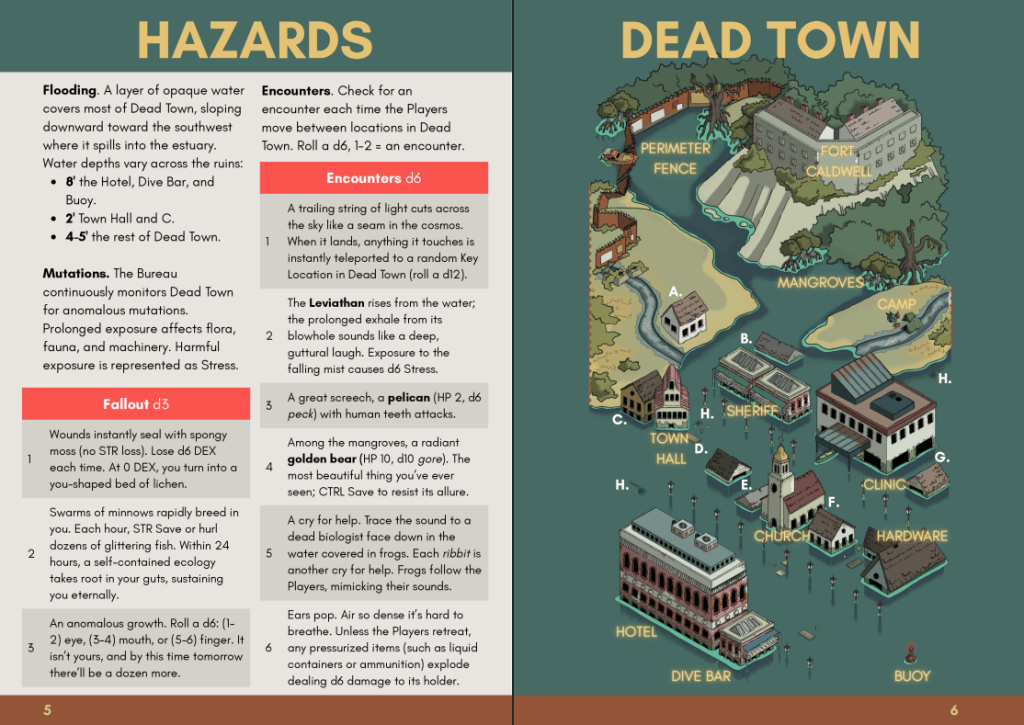
I always keep encounters on the same spread as the map for easy reference while players are on the move. The encounters focus entirely on Dead Town as a threat. The first draft included the Rogue and the Biologists–something I’d do for Into the Odd–but Liminal Horror uses the Doom Clock mechanic for factions. This frees up the encounter table for environmental hazards rather than faction actors.
Designing a fallout table was a lot of fun. When I ran Shelterwood I noted that one of the system’s strengths is unique fallout tables for each adventure. That kind of foreground change is core to OSR-style play; players love seeing characters permanently altered, with specific memories tied to each change.
Like my encounters, the fallout table went through several drafts and was compressed from a d6 to a d3. I combined redundant entries and eliminated fluff. Honestly, a player will likely only roll on this once or twice, so you don’t need more options than that.
The map is the heart of this adventure. I spent more time than usual drawing and re-drawing this until it looked the way I wanted. I knew from the outset it would be isometric; isometric perspective is oh-so-charming (it exudes a vibe of play, like little dollhouses), but my main inspiration was pictures of flooded towns. For most of my life, I’ve only seen views like this from news helicopters or drones; I wanted to evoke the same feeling here.
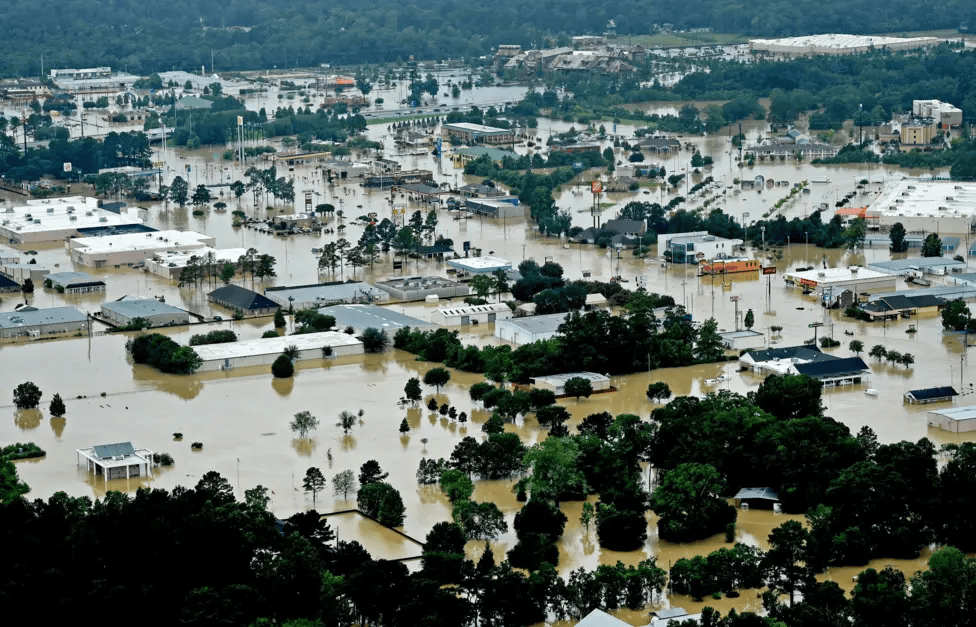
I’m sure we will see even more images like this in the next few years, and probably coming out of places where it’s never happened before. There is real subtext in this adventure as I contend with my own fears of climate collapse and infrastructure loss. Most of my own downtown is on track to be underwater in the near-future, too.
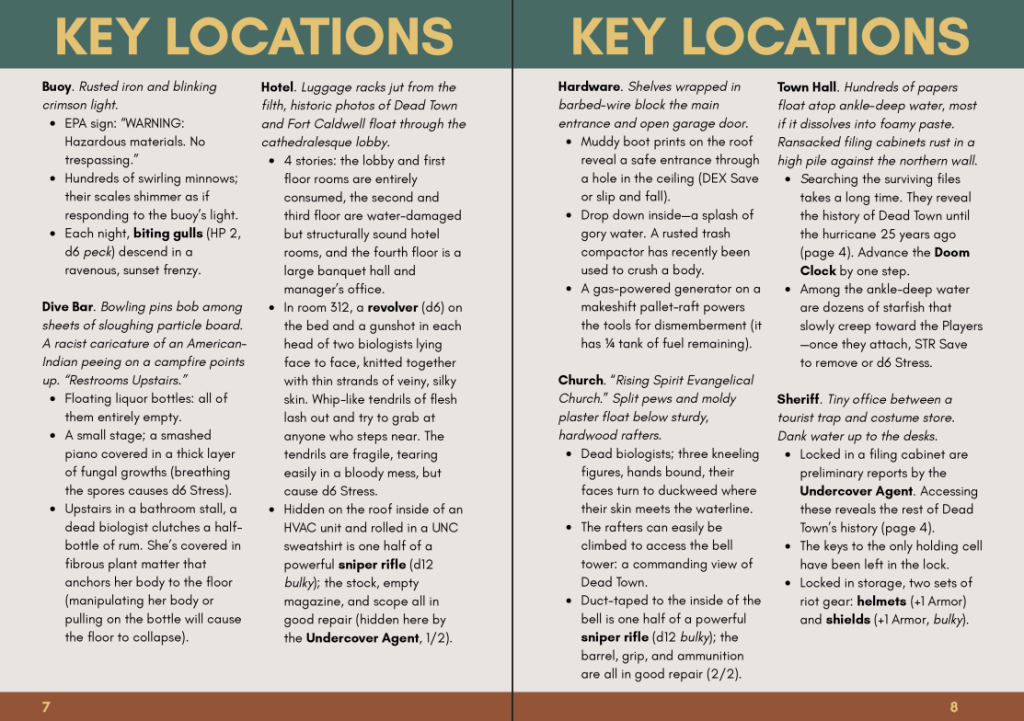
The next six pages cover Key and Minor Locations. Very little was cut, even if the writing seems lean. The adventure is designed for experienced GMs who can improvise from terse descriptions, though I’ve included 10 modular clues to drop anywhere players explore that isn’t detailed.
I’m a big fan of iceberg theory–the deeper meaning of each location is implicit. This saves space and better aligns the text with the players’ headspace: sometimes there are no easy answers.
To demonstrate iceberg theory across the three spreads, I’ll spoil one example from each. First: a church with dead biologists turning into duckweed. Why are they here with bound hands? A possible answer is implied in the church description. The Undercover Agent stashes equipment here so perhaps they also hide the bodies of anyone who uncovers their identity. As for the mutations? The agent is just as shocked as you are.
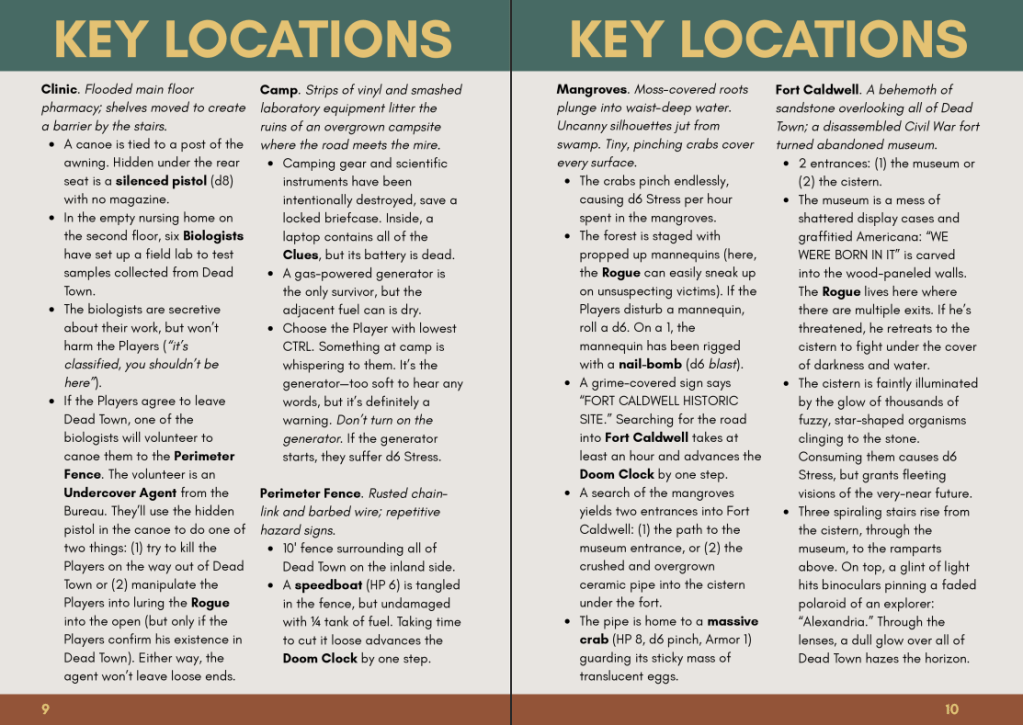
Second: binoculars and a polaroid on the ramparts. It depicts a woman and is labelled with a name, Alexandria. This is the Rogue’s roof, for all intents and purposes, so he’s the one using the binoculars. I think he’s keeping an eye out for Alexandria, somewhere in the swamp. Who is she? Well, she’s wearing expedition clothes so she probably entered Dead Town with the Rogue 25 years ago. We also have a clue on page 15 of a heart-shape carved into wood (“A + J / 2002”) and a note in an inoperable shotgun: “Alex, took this from the bar on day one. Empty, but you can threaten him with it if things get out of hand.”
One can deduce that when the Rogue entered Dead Town he started an intense romantic relationship with another expedition member. Obviously this dissolved due to drug use and “the Primordial Soup.” Whatever happened, he’s still hoping she’ll turn up somewhere in Dead Town.
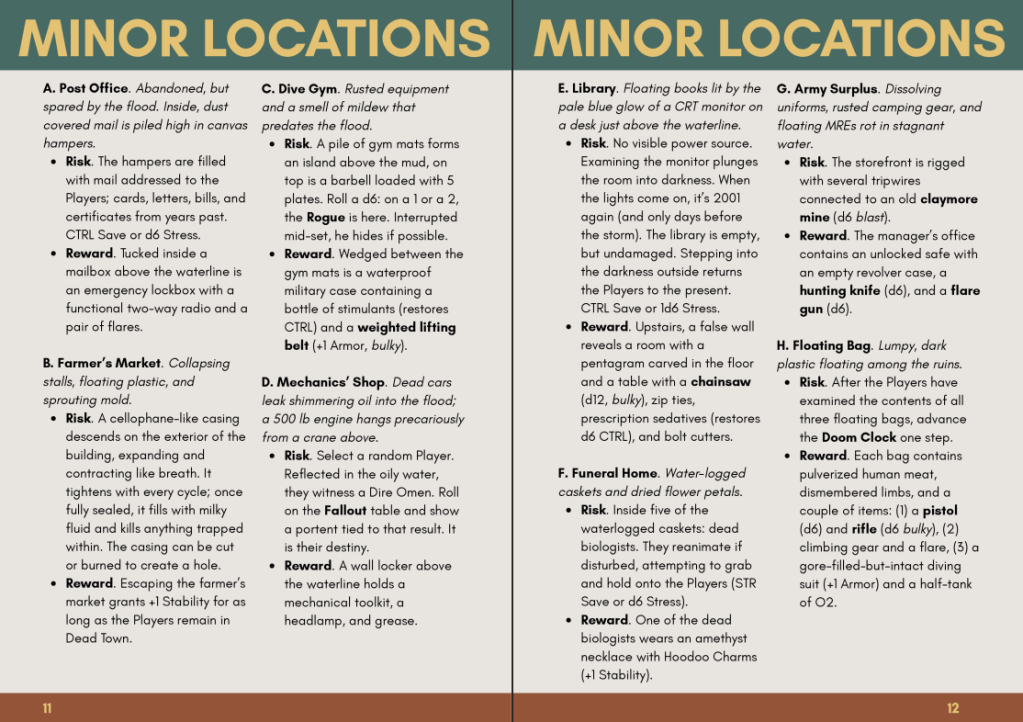
Third: a secret satanic headquarters in the library. What’s up with that? We know from the background that this area has been ~weird~ long before the flood, and I like the idea of long-standing occult activity in Dead Town (this is a pretty direct reference to Absolution by Jeff VanderMeer). The villagers weren’t helpless victims of an unknowable enemy; they were curiously poking and prodding whatever presence is here for generations before the flood.
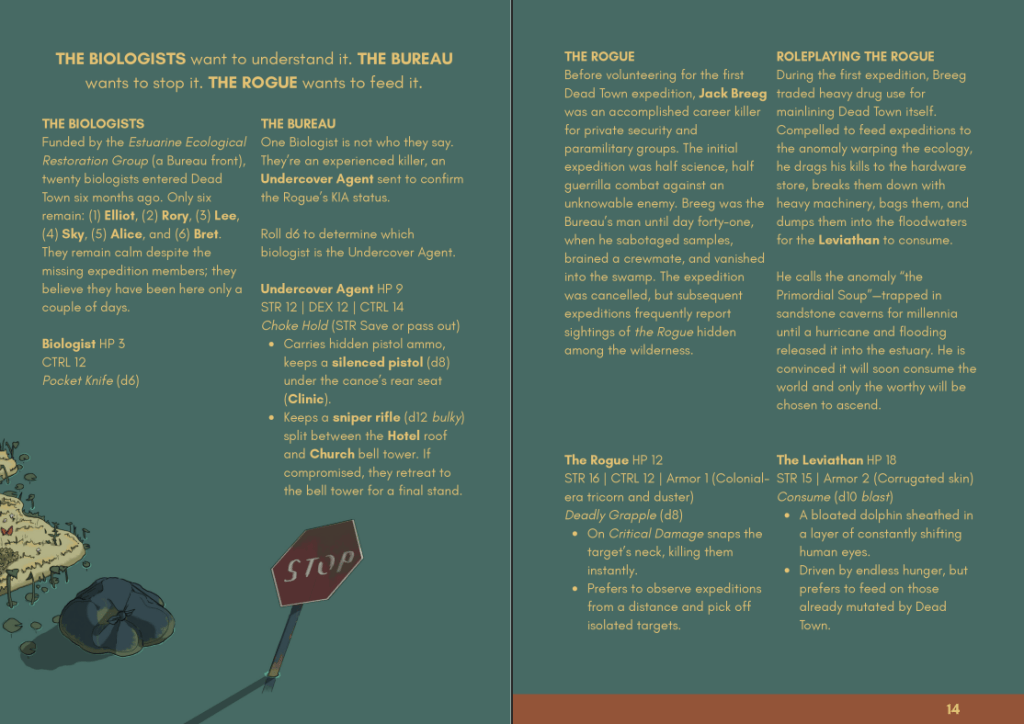
After six pages of text, I wanted this spread to feel like a breather–a change of pace. First, you’ll notice the bottom-left illustration, though its significance won’t make sense until the final column. I like that, just as I like how each faction description flows into the next.
This spread lists the Leviathan alongside stats for faction members. At first, the Leviathan was going to be a mutated sperm whale (from Hook #1), but I was embarrassingly deep into the project before realizing a sperm whale couldn’t swim through Dead Town’s shallow waters.
I felt insane for a few days switching it to a bull shark, only to realize they lack blowholes (for Encounter #2). Wanting to keep the page 5 Leviathan encounter unchanged, we ended up with a hungry dolphin. That’s still scary, right?
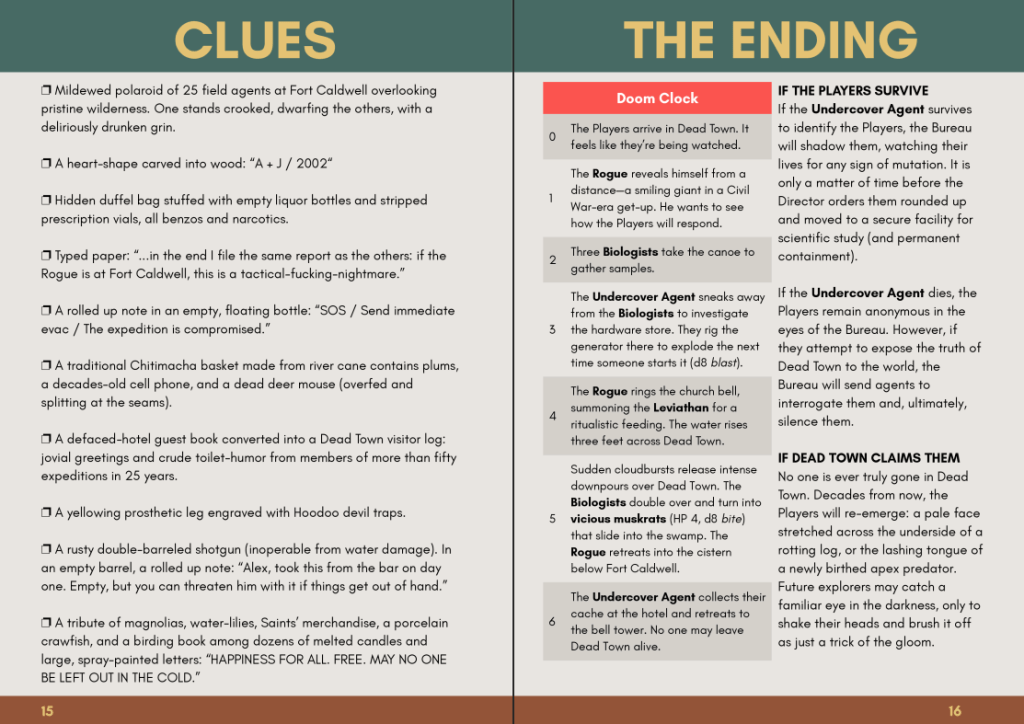
The last spread of writing is mostly GM utility. We have our ten modular clues. Inspired by the Carved from Brindlewood system, these clues are vague enough for players to establish their own theories, though there’s no requirement to “solve” anything–the adventure is about survival.
The Doom Clock was a lot of fun to write. I framed it as Dead Town reacting to the players’ arrival. The first four steps are “a day in the life”–the usual faction behaviors. Things escalate dramatically when Dead Town turns on the biologists, transforming them into vicious muskrats. I love this; it’s exactly my brand of cute/spooky. Though it seems random, it isn’t. Dead Town has watched them collect samples and graze through the marsh for months, so it chose a more appropriate form for them.
I love the idea of the adventure ending in the pouring rain, with the Undercover Agent firing high-powered rifle rounds as the players make a desperate escape. But the real strength of the Doom Clock is how it helps roleplay antagonists after player interference. For example, if players find and take the agent’s cache, step 6 changes completely: the agent still tries to kill them, but must adapt tactics (meaning the GM does, too). I love when adventures take unexpected turns–that’s when GMing feels like playing and I can fully immerse myself in my characters.
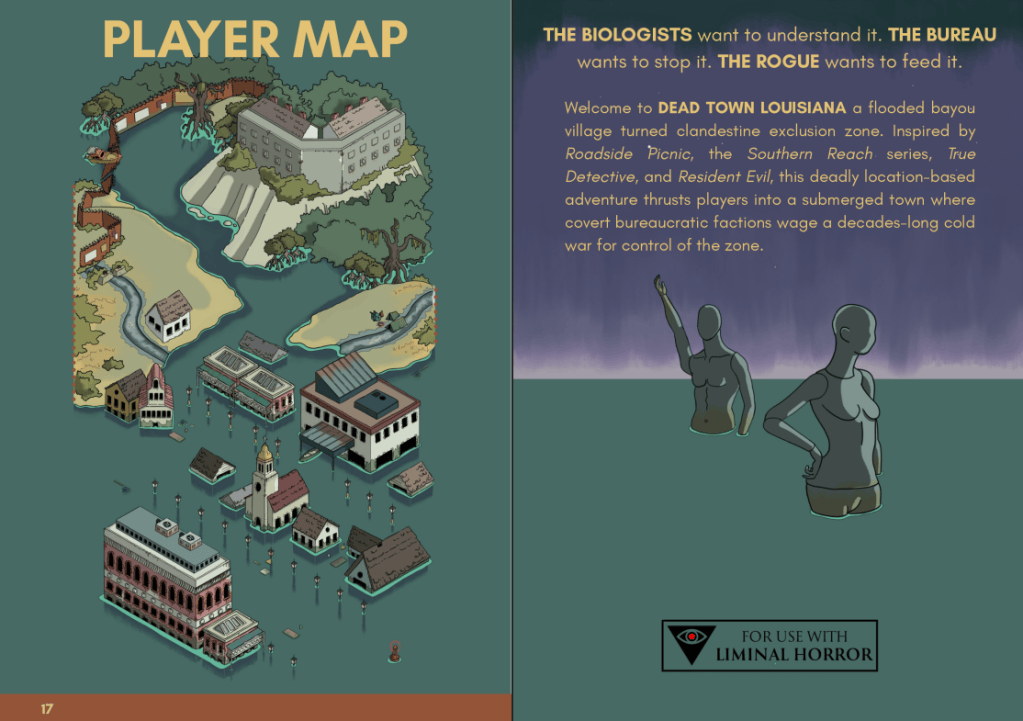
There isn’t much to say about this final spread: we have a blank map to put in front of the players and a final illustration. I like how on the back cover some time has passed since the sun set on the front cover. I hope it gives the feeling that it got much darker while you were reading–and when you lift your head, you’re somewhere else entirely.


Leave a Reply