This month, I’m reading Dead Astronauts by Jeff VanderMeer. It’s the sequel to Borne—a novel I absolutely adore for its refusal to hold the reader’s hand. VanderMeer respects the reader; he drops a disturbing piece of worldbuilding, moves on, and trusts you to sit with the implications. But Dead Astronauts feels less like a traditional narrative and more like a fever dream. The prose is heady, the plot moves with a surreal, hallucinatory cadence, and while I love every second of it, I’m frequently left wondering if I’m too high or not high enough to really get it.
In a novel, that kind of beautiful disorientation is part of the joy. If I lose my footing, I can slow down, re-read a passage, or parse the text at my own pace. But a ttrpg is a different beast entirely. A tabletop plot is a living, ephemeral thing; it happens in real-time, exists only in the moment, and can’t be flipped back a few pages when a player loses the thread.
This leaves designers with a fascinating challenge: how do we build surreal, vibe-heavy worlds while keeping our players grounded enough to actually navigate the fiction? It’s a precarious tightrope walk, but it’s a balancing act that In a Petal Unlimited absolutely nails.
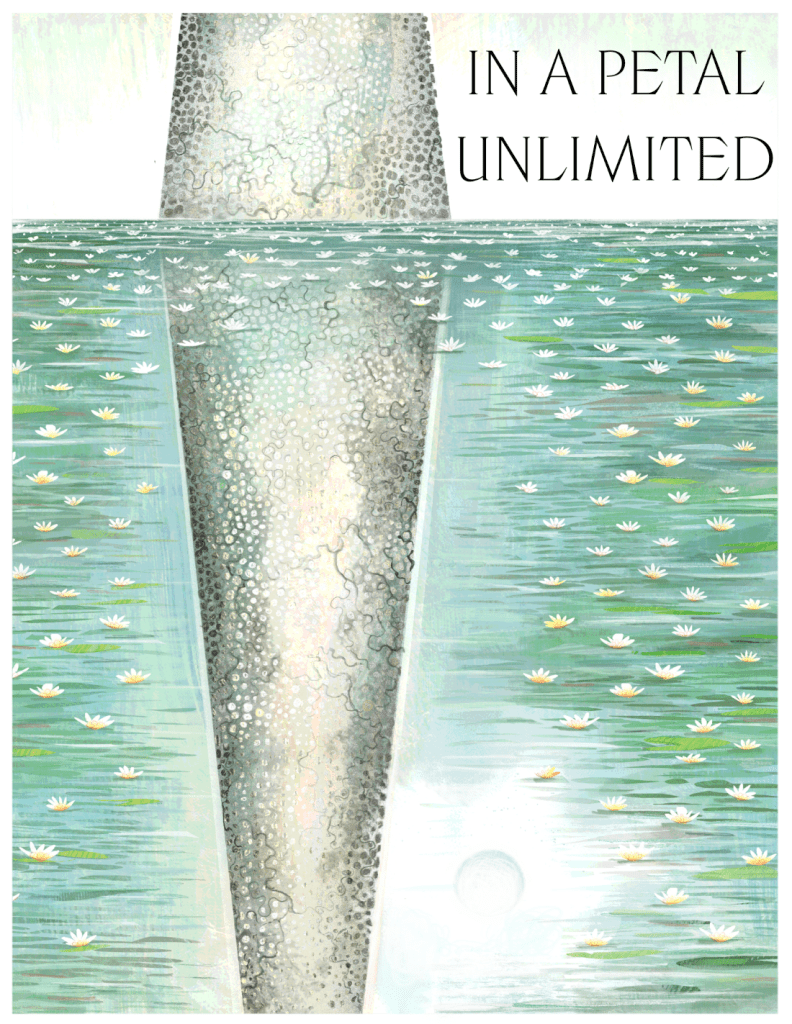
In a Petal Unlimited is a 23 page adventure for Cairn (although designed for Wyrm, which I have not played). Words and interior art are by giant robot tackler. The cover illustration is by Apollo (@poliaths).
“At the sea’s center, a blocky spire lunges upward, tall as a lighthouse and twice as thick. Fresh vines form a lattice on its surface. Large birds flit to and fro – a vertical ecosystem… Every hour, on the hour, a single wave pulses from the spire.”
The Surreal, Grounded
Among the adventure’s cited inspirations is VanderMeer’s Annihilation. In that novel, Ghost Bird/the Biologist is driven into a hallucinatory, deeply personal nightmare of ecological terror. In a Petal Unlimited riffs on those same visual themes while deftly avoiding the trap of becoming an unplayable, avant-garde slog. It stays grounded by giving the Warden concrete tools. The NPCs are sharply sculpted, allowing you to easily convey the vague sense of *intimacy* the locals feel toward their strange environment. The adventure offers a brilliant structural hook: the players are following the trail of a missing expedition. This is exactly how I opted to run the Iron Coral; *rescue* the missing explorers is a much better verb than *experience* the weirdness.
From the Tavern to the Spire
The adventure comes out swinging with one of the best ~meet in a tavern~ setups I have ever seen in a one-shot. The tavern here is the Last Vespers, a rudderless barge guided gently along by swarming minnows. I immediately wanted to run this adventure based on the concept of the Ship alone. The Ship acts as a launchpad for fantastic hooks–most notably Bill Billions and his experimental flying machine. I deeply appreciate that the flying machine offers a fun, open-ended escalation that can completely upend how the party approaches the Spire. I would have so much fun embodying Mr. Billions.
Once the players begin their ascent, the module introduces a falling mechanic that made me incredibly jealous as a designer. I can instantly picture the spongy, gentle fall into the black grass, and the elegant way momentum actually makes the landing worse for the player. It’s the exact kind of physics-based hazard that is effortless to make a ruling on because you can vividly see it in your mind’s eye.
The Spire encounters themselves all feel like they organically belong to the vertical ecosystem, presenting highly believable hazards for climbers. The believability is reinforced as the ecosystem dynamically shifts across Morning, Noon, and Evening watches.
My personal favourite is Noon: the oppressive heat drives desperate squirrels to frantically tear into the characters’ waterskins. Perfect.
The Delve
When the party transitions into the dungeon encounters, the writing remains sharp, pointed, and clearly remembers to have fun with the language. The environmental events are the absolute standout here. As I was reading, I found myself wondering: what happens when the tower pulses while the PCs are inside? I wasn’t disappointed by the answer.
A personal favourite of mine is Room 6, the Phase Error encounter. It features an NPC whose age flickers every time you blink, sitting over a chest that duplicates into unfocused images. It is exactly my kind of encounter–deeply weird, interactive visuals. The environmental *weirdness* adds a literal justification for a combat encounter with multiple phases, as the NPC splits into copies of herself on Critical Damage. It’s the kind of out-of-the-frying-pan action writing that I prefer over a traditional slugfest.
Shape-Shifting Conclusions
The dungeon’s surrealism reaches its peak in Area 12 where the players encounter a massive, tumorous heart, forcing out a single, torturous beat each hour. I won’t spoil the adventure, but the designer beautifully gamifies the climax by providing concrete mutation tables based on the party’s moral choices.
Ultimately, the conclusions offered at the end of the adventure maintain the exact same grounded approach: the consequences of the players’ actions are beautifully and heavily described, but refreshingly, they are not over-explained. It leaves the mystery intact, trusting the Warden and the players to sit with the implications–much like VanderMeer would do.
 Bath Imaginable
Leave a comment