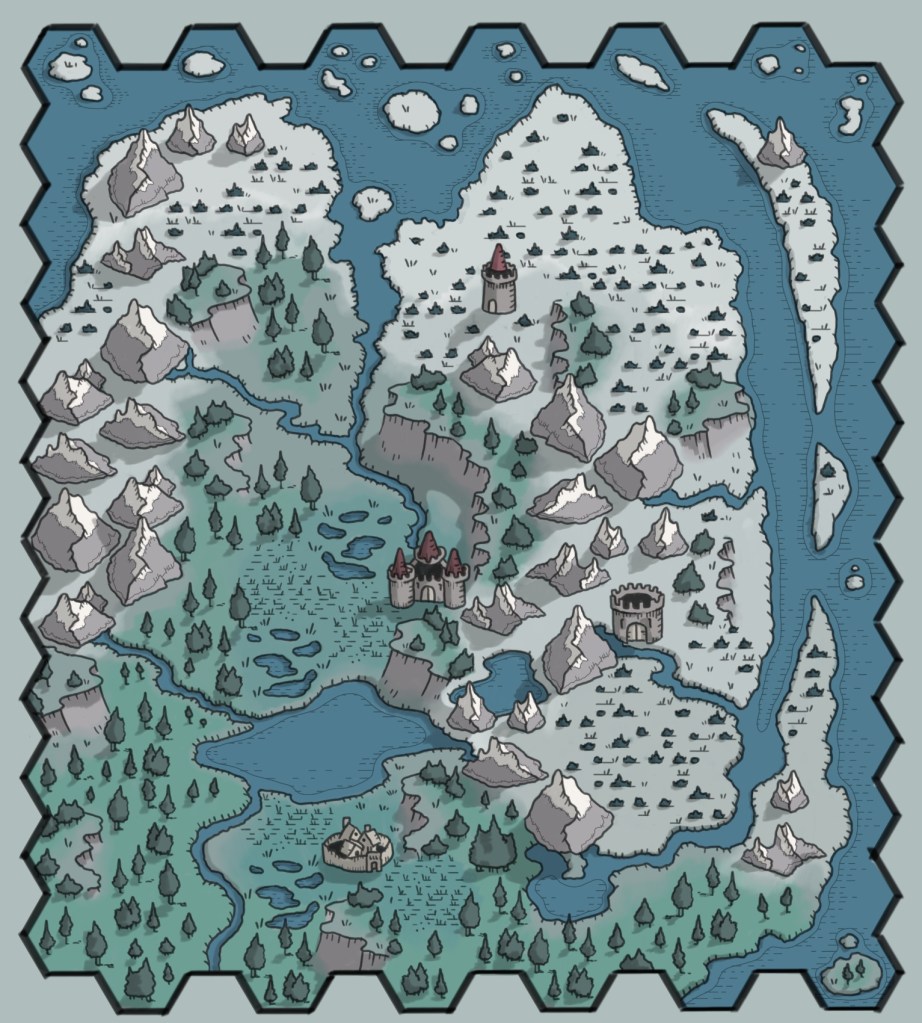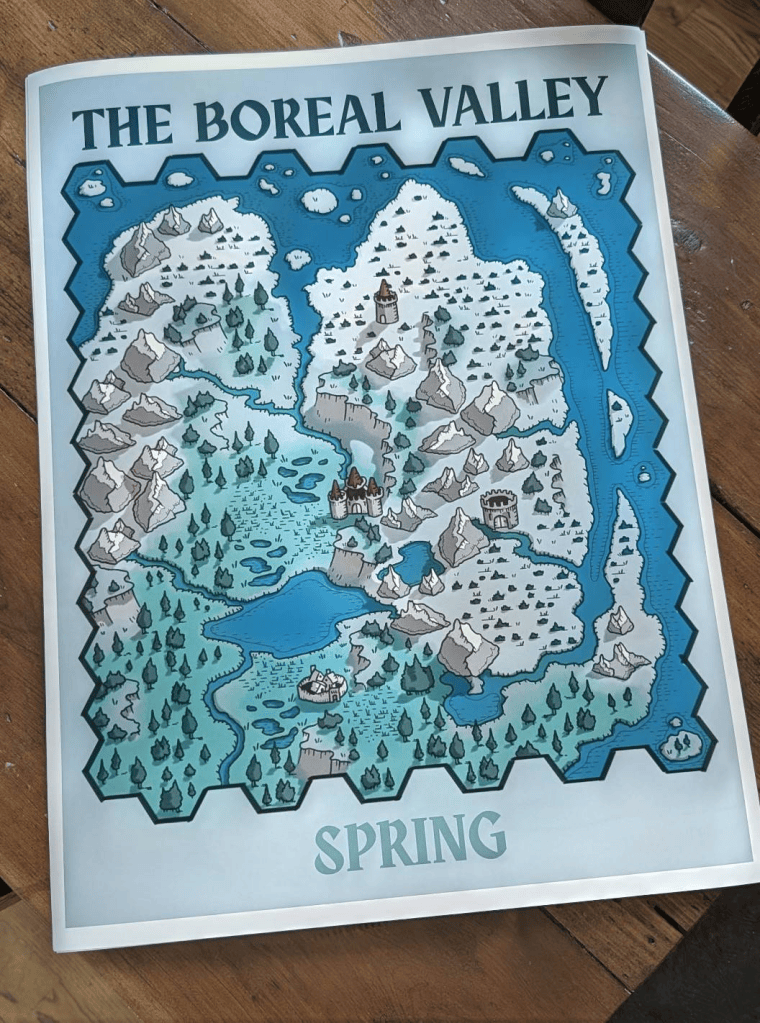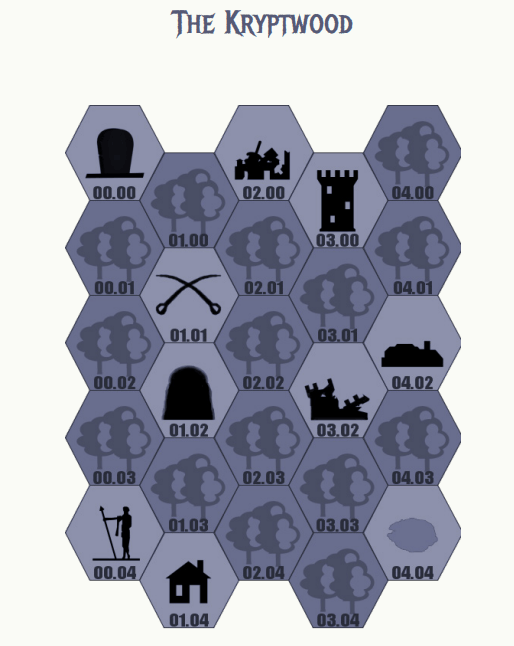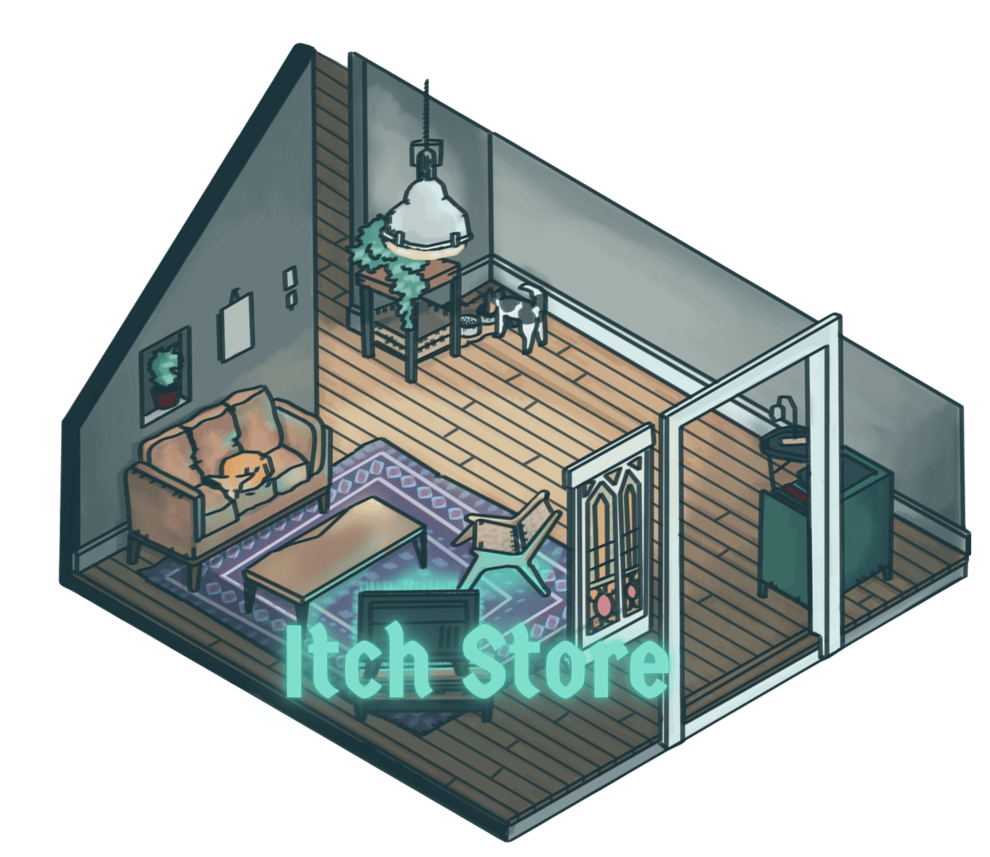
You know what’s cringe? Falling in love. Telling your friends that you value them. Getting earnestly excited about your hobbies. Being vulnerable with others.
You know what else is cringe? Asking acquaintances in your life to play ttrpgs with you, and getting over the fear of mixing different groups of people in your life over a shared hobby.
It’s pretty cringe to go up to someone and ask them what kind of fiction they like, to talk to them about their favourite books and music and movies in an earnest, curious way and then invite them to try a social, collaborative storytelling game. You might have to explain that these games often lean into pulpy, action-movie stakes. It’s just an excuse to solve wild problems we’d never encounter at our day jobs. Plus, you get to do funny voices–you don’t have to, but you can if you want to (I do when I’m inspired to).
You get to practice being a hero, it’s pretty cringe.
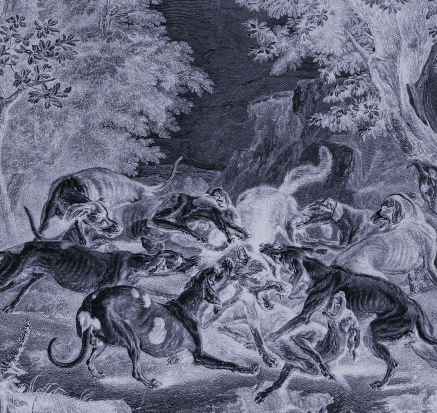
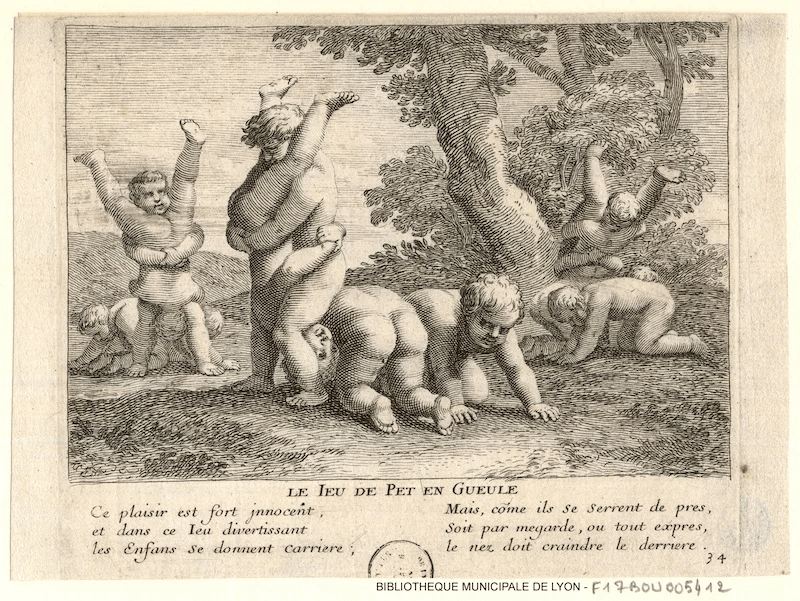
Art by Claudine Bouzonnet-Stella, Jacques Stella
If you’re looking for players, you need to ask the people that you know and meet them where they’re at. A lot of them might surprise you. I play regularly thanks to advice from articles like the open table manifest by the Alexandrian.
It’s pretty cringe to be worried about how you look if you’re doing what you love.
I have a lot of opinions but that doesn’t mean I’m a good critic. I think if you want to know whether you might like Public Access, you need to watch this video by Quinns Quest. You probably already have.
Art by the Gauntlet.
I agree with many of Quinns’s takes on the game, and the Brindlewood Bay mystery engine as a whole (which I already wrote about, here), so I’ll just get right to my aforementioned opinions.
It does at times feel like the designer is handing you his personal game notes and saying “you figure it out,” but that is also what is truly so good about it. If you put your faith in the system and allow yourself to be as surprised as the players, you’re going to have a good time.
I had to change the way I thought about running RPGs. I realized, I don’t need a map of the house on Escondido Street to have a really chilling horror scene take place there. With the right clues and the right attitude amongst the players, the scenes just flowed.
And of course… the notes that Cordova has handed you are airtight; modular clues, each of them chilling in their specificity and a number of flavorful vignettes at your fingertips let you riff effortlessly while staying in the moment with your friends.
Still, I felt myself missing my locations’ based adventures over scenes’ based improvised play. I loved being a player in Brindlewood Bay, but as the Keeper in Public Access I often missed what good environmental storytelling has to offer when every clue is in its most plausible home.
Another major difference between the locations-based, more OSR-style games I’m used to is that Public Access has a very rigid play structure. It doesn’t have many rules; you’re almost always just rolling 2d6 and adding a modifier, hoping for a high result, but the day/night phases, the way that watching a TV Odyssey tape is meant to be its own, structured mini-game, and the rules around the inventory items in your corner of the house all compound to strip away the immersion of exploring a ~real place~ in favor of collaboratively constructing scenes.
In other words, the roleplay feels less like being an actor immersed in a character and more like being a showrunner in a writer’s room. Your mileage will vary.
But then I played my sixth session, and something clicked into place…
Public Access (Returning Series)
(1) Pilot/the House on Escondido Street. In the summer of 2004, three young adults—Stefani Oakes, Erika “Spud” Serrano, and Timothy “Skywalker”—rent a house on Rodenbecker Street in Deep Lake, New Mexico. Calling themselves the “Latchkey Kids,” they investigate TV Odyssey, a defunct public access studio from their childhood that the rest of the town insists never existed. When an old friend, Casey Wilcox, drops by with stories about the Rappaports—a family that vanished from their home on Escondido Street—the group investigates the abandoned property. There, they contend with supernatural threats and discover a horrifying connection to TV Odyssey, ending the night with an unexpected visit from the local police.
Needle Drop. “Toxic” by Britney Spears
(2) Greetings, Travelers. The Latchkey Kids are pulled into a local crisis when Sheriff Bill Hanscom enlists their help to find Amelia, a missing teenager who recently lived on Rodenbecker Street. Their investigation leads them to Serpents and Sepulchers, an underground table-top roleplaying game linked to historical disappearances in Deep Lake. As the mystery deepens, Stefani revisits her old campsite at Pine Rock Ridge and uncovers urban legends about the “Deep Lake Lurker,” while Spud seeks spiritual aid from Father Lopez to cleanse the Escondido Street house. Meanwhile, Timothy makes a dangerous decision to watch a newly recovered TV Odyssey tape alone. The Latchkey Kids’ search for Amelia leads them to a late
Needle Drops. “Cute Without the ‘E’ (Cut From the Team)” by Taking Back Sunday, “Ocean Breathes Salty” by Modest Mouse
(3) The Whisper. Following a chaotic late-night confrontation with a local cult known as the Black Leaf Circle, the Latchkey Kids scramble to cover their tracks. A power outage on Rodenbecker Street leaves Spud home alone to face an eccentric electrician and the haunting memories of “The Whisper”—a psychological supernatural phenomenon that tore her family apart years ago. Timothy encounters an enigmatic figure known as the Big Man, who offers a cryptic warning about an imminent threat at the lake. Racing against time, the group heads to Pine Rock Ridge to save a camp counselor from the shifting dangers of the Deep Lake Lurker, only for the environment to turn deadly.
Needle Drop. “Take It Easy (Love Nothing)” by Bright Eyes
(4) Deep Lake. In the immediate aftermath of the lake incident, the Latchkey Kids scramble to find a way to break the regional curse of the Deep Lake Lurker. Uncovering hidden diaries and anomalous coordinates left by a mysterious benefactor, the group begins to piece together the true identities of the people running the Black Leaf Circle. While Spud and Timothy launch a raid on the cult’s headquarters, Stefani finds herself caught in a deceptive trap out in the New Mexico desert. The three friends must reunite to face the ancient, predatory force behind the town’s disappearances, resulting in a traumatic confrontation that changes two of the Latchkey Kids forever.
Needle Drops. “Don’t Bring Me Down” by Electric Light Orchestra, “Mad World” by Gary Jules, Michael Andrews
(5)Starlight Kingdom. While dealing with intense police scrutiny from Sheriff Hanscom regarding the recent violence in Deep Lake, the group attempts a dangerous cleansing ritual to finally put the Deep Lake Lurker’s restless spirits to rest. Seeking a distraction, Casey Wilcox invites Stefani on a date to Starlight Kingdom, an abandoned local theme park. Convinced the park is tied to the broader TV Odyssey mystery, the entire group tags along. After interacting with eccentric locals and consuming a strange psychoactive beverage, the Latchkey Kids take a ride on a defunct attraction, unlocking a terrifying ability to decipher the supernatural forces surrounding them.
Needle Drops. “Clumsy” by Our Lady Peace
(6)Los Ojos. Father Lopez recruits Spud to help him investigate a series of gruesome animal attacks around the county. The two search a local cave system and discover the nest of a local cryptid, the Deep Lake Devils. The hunt takes a deeply personal turn for Father Lopez. Meanwhile, Timothy and Stefani go to the Playa Morado housing development to find the man-made source of the Whisper. Their meddling leads them to an underground data bank and an encounter with the Big Man. After the data is destroyed, Timothy and Stefani watch a TV Odyssey tape at home. Spud stays out late to help save a trapped spelunker, recruiting the help of an eccentric, thrill-seeking rancher named Glenn. The next morning, Stefani learns that a childhood friend might be in danger.
Needle Drops. “High and Dry” by Radiohead, “Crash into Me” by Dave Matthews Band
Art by the Gauntlet
Epiphany
If you’d asked me at Session 4, I would have said Public Access was a fascinating experiment that just wasn’t for me. I missed my personal joy of OSR-style prep–keying rooms, the objective truth of a dungeon map, the feeling of players discovering a world I had crafted like a creepy little dollhouse. At times, the ~writer’s room~ vibe felt like a compromise, trading deep character immersion for collaborative screenplay writing.
But now, something has shifted. In an episode we had Father Lopez and Spud hunting cryptids in the caves, Timothy and Stefani breaking into a corporate data bank, the sudden, weird appearance of a thrill-seeking rancher named Glenn–it started to feel like a real TV show, with weird highs and weird lows (think Supernatural or Buffy). I stopped trying to force the game to be a traditional mystery with a neat, pre-planned solution, and just let the chaotic, nostalgic, 2004-era weirdness wash over us.
And that, I think, is the point of sharing this mid-season reflection: you have to unlearn your old GM habits to let this engine work its magic.
If you try to fight the structure, or if you spend your prep time wishing you were running a hex-crawl, you’ll miss the emergent horror TV vibe this game is designed to create. But once you surrender to the ~showrunner mindset~ the payoff is incredibly rewarding.
We are more than halfway through the campaign, I plan to finish it before the end of summer. The tapes are spinning, the Latchkey Kids are in deep, and for the first time, I am genuinely dying to see how this weird, terrifying story will end.
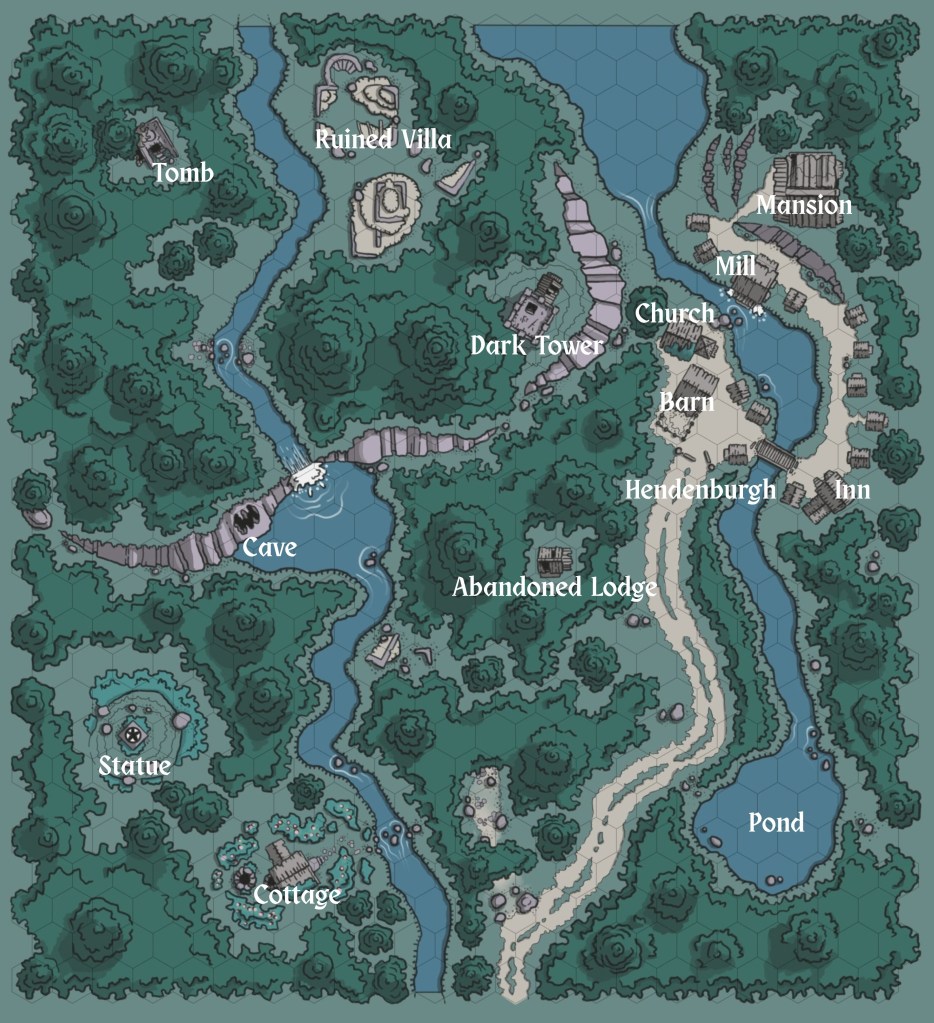
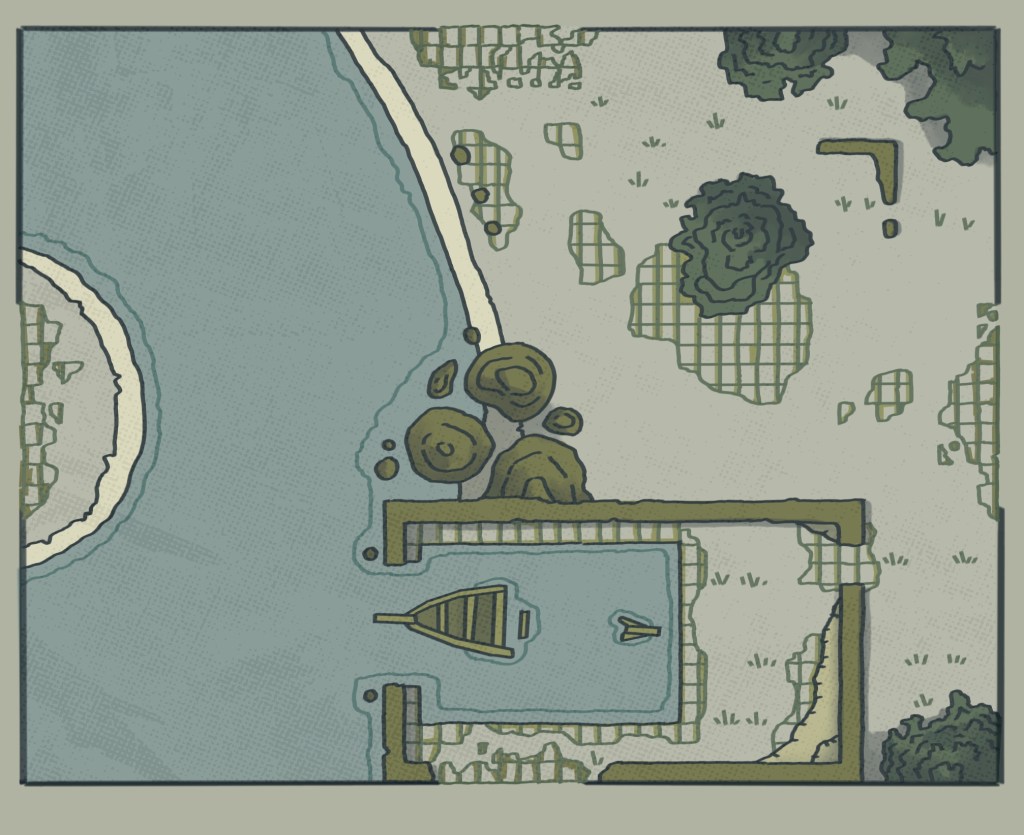
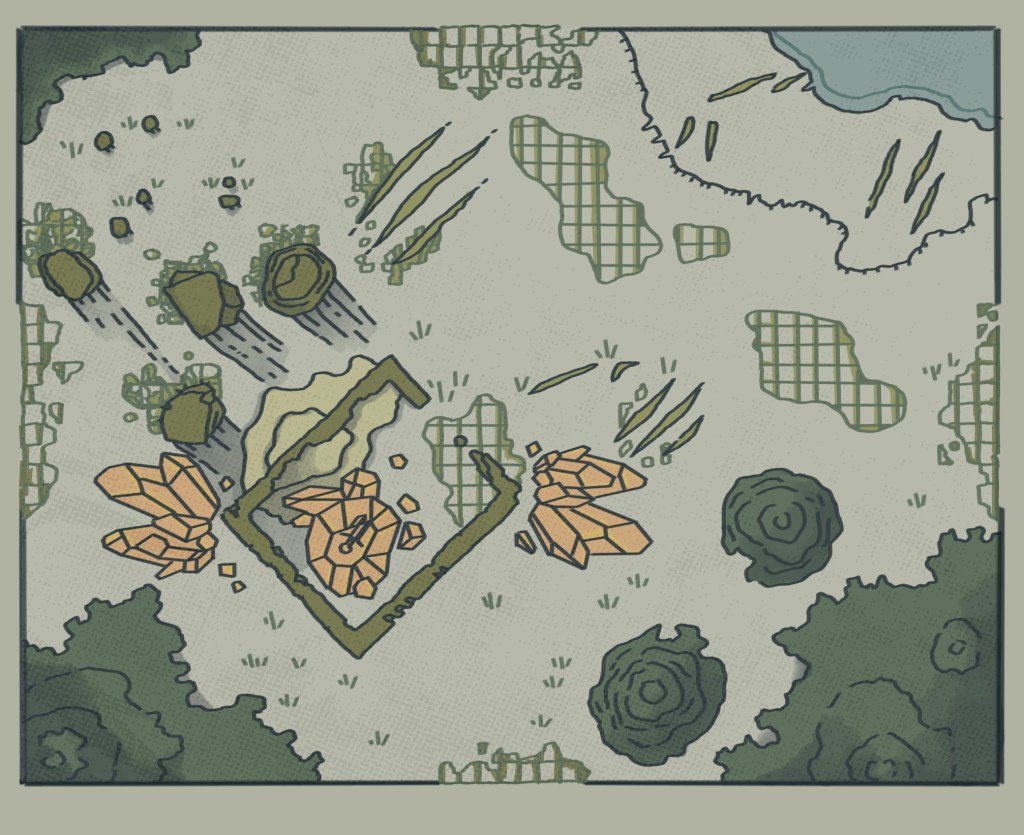
My submission to the Appx. N Jam 2026 is now live on itch.io, you can check it out right here. The adventure turned out differently from my initial thoughts once I got to the art phase of the project. I thought it could be a fun exercise to compare how my ideas translated to the page, and dig into why I made the choices that I did.
I was limited to four A5 pages (in other words, both sides of a single, letter-sized piece of paper), so let’s take a look at each page in order.
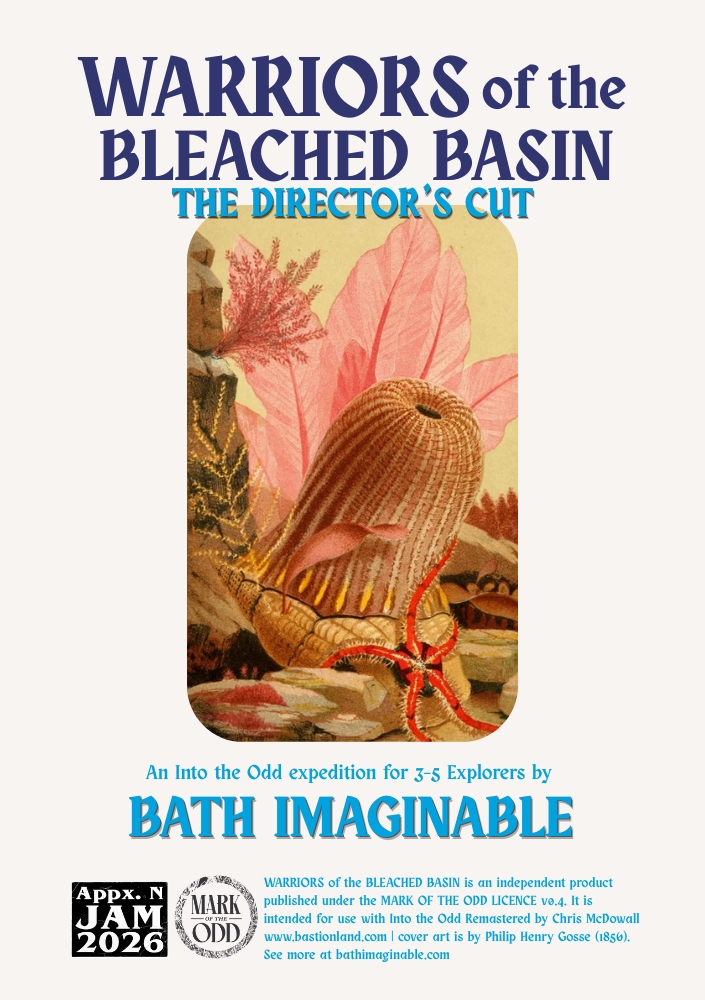
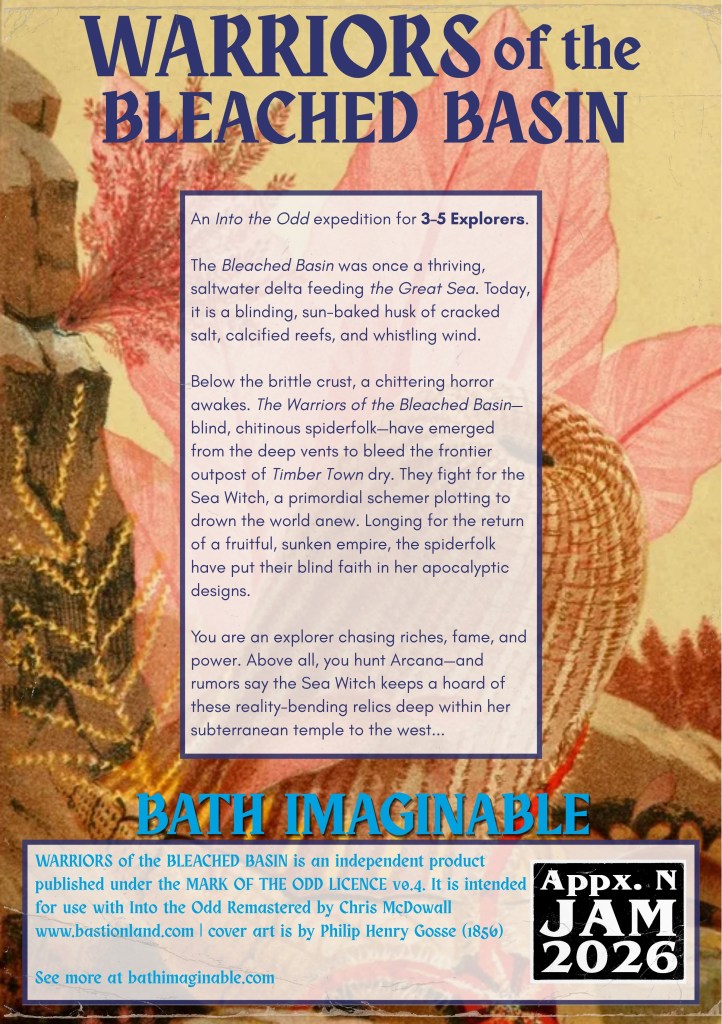
Cover Page
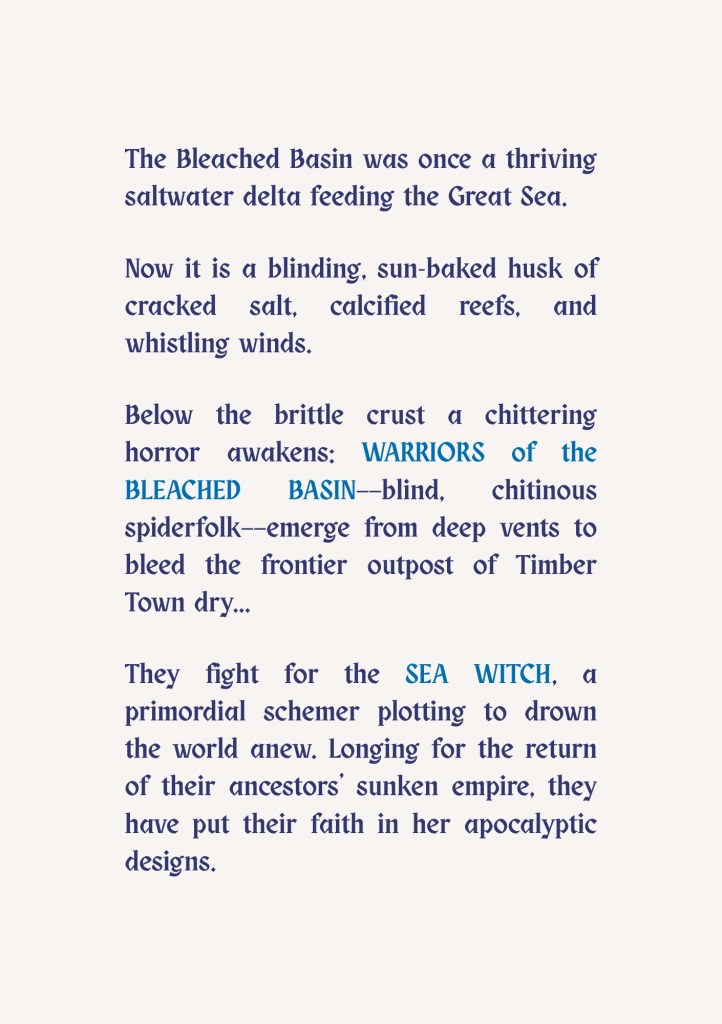
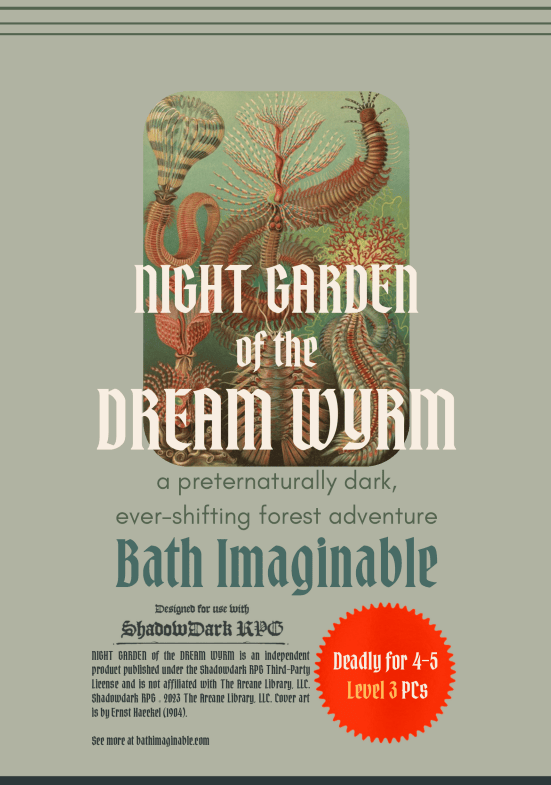
I knew I wanted a cover page, despite it occupying 25% of the available space. I originally thought I would draw one of the industrialists from Timber Town wielding a fire whipper and keeping a couple of reptilian warriors at bay, but none of those ideas made it into the final draft and when I started diving into public domain illustrations of corals, I fell in love with the alien vibe Philip Henry Gosse’s 1856 illustrations brought to the cover. The font and color contrast helps sell the science-fantasy vibes without many words.
But there are still words. I wrote previously about the good use of verbs in the Cairn adventure, In a Petal Unlimited, so I wanted to make sure my cover page also provided a clear hook: find the treasure.
I had wanted to offer six hooks as an opportunity to expand the worldbuilding, but decided not to; I’d prefer more of my precious word count be spent on describing the setting and its inhabitants knowing that an inspired GM could find other implied hooks. I’m a big fan of iceberg theory.
Dungeon Key
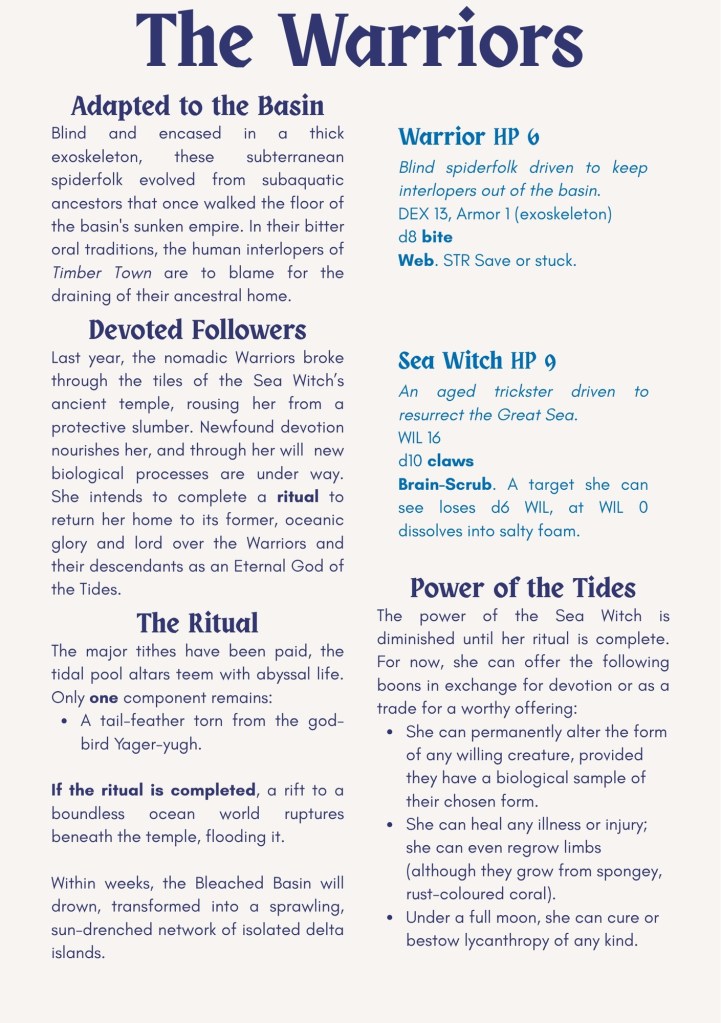
Originally, I thought the entire adventure would be a wilderness crawl, but after pushing my ideas into the proverbial brown-bag of the back of my mind to let them ripen, I decided that a tight, five-room dungeon could offer a lot of narrative in a limited amount of words.
I had always planned on there being a couple of adventure locations on the map, but I combined the ancient lighthouse and warriors’ temple ideas into a single location and cut anything that didn’t add to the story.
I don’t usually add “if this, then that” type text to my adventures, but since this one is designed to be a one-shot I thought it would be fun to add some world-changing stakes. The Ritual also ties in Yager-yugh from the final page, and offers a potential moral dilemma for outsider player characters not endeared to Timber Town.
Maybe it’s just me, but I find the Sea Witch much more sympathetic than the folks of Timber Town given our real-world man-made ecological apocalypse is already well underway.
Dungeon
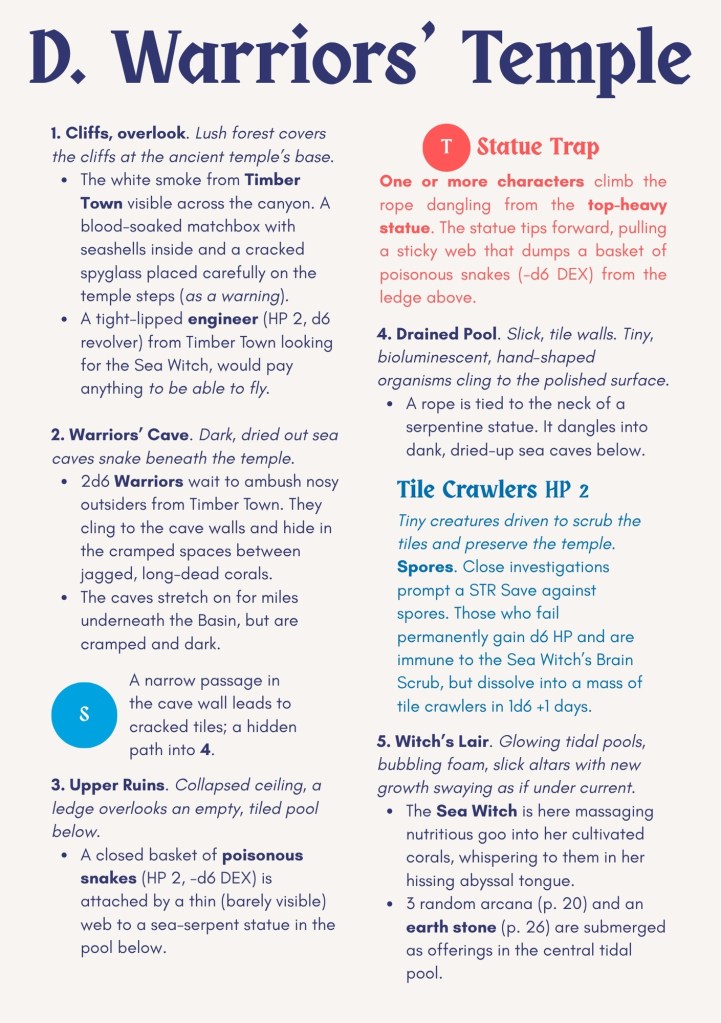
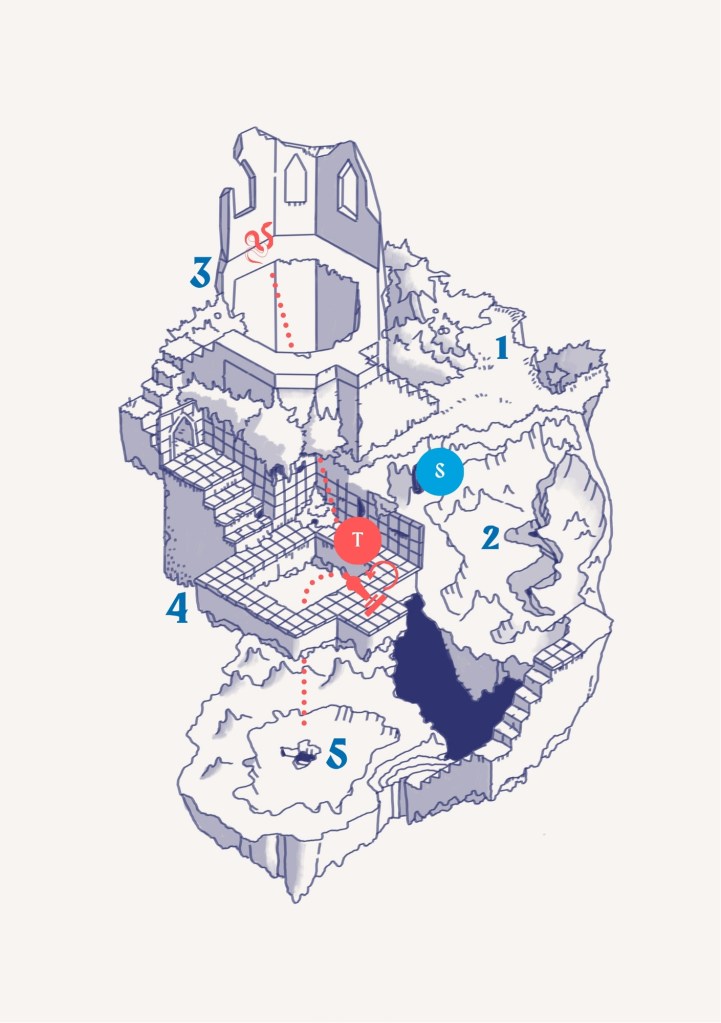
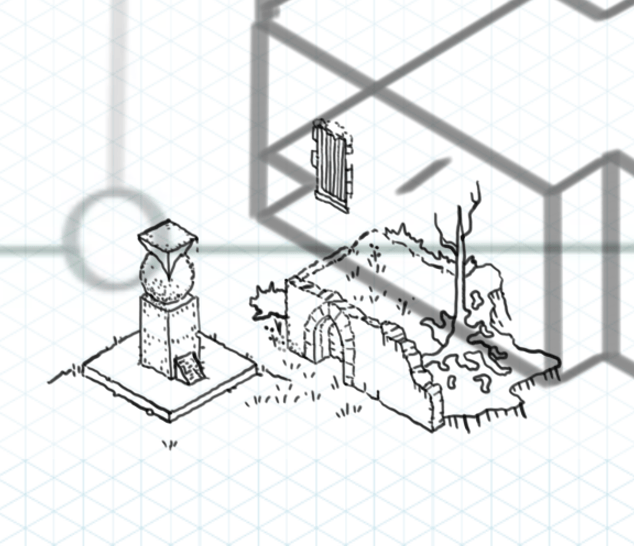
My favourite thing about isometric dungeon maps, besides their dollhouse-like vibes, is the way they communicate verticality. I really wanted to lean into that with this statue trap, set up by the Warriors to get the jump on anyone from Timber Town (or other nosy explorers) looking to rob the temple or interrupt the ritual.
The isometric perspective also makes it very clear how all of the rooms connect, which is important when my word-count is so limited. I didn’t have to spend any time describing how a fall from 3 leads straight through 4 to 5; it’s clear in the visual design.
Back Cover
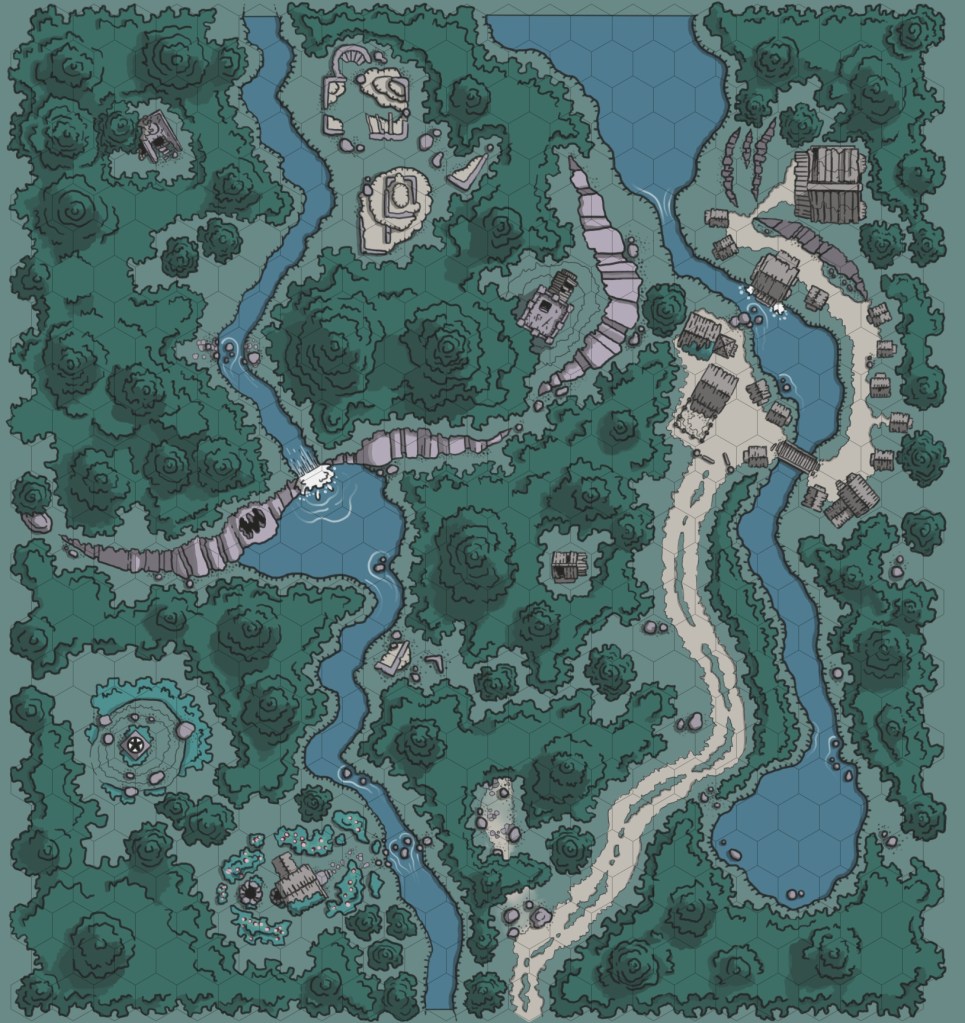
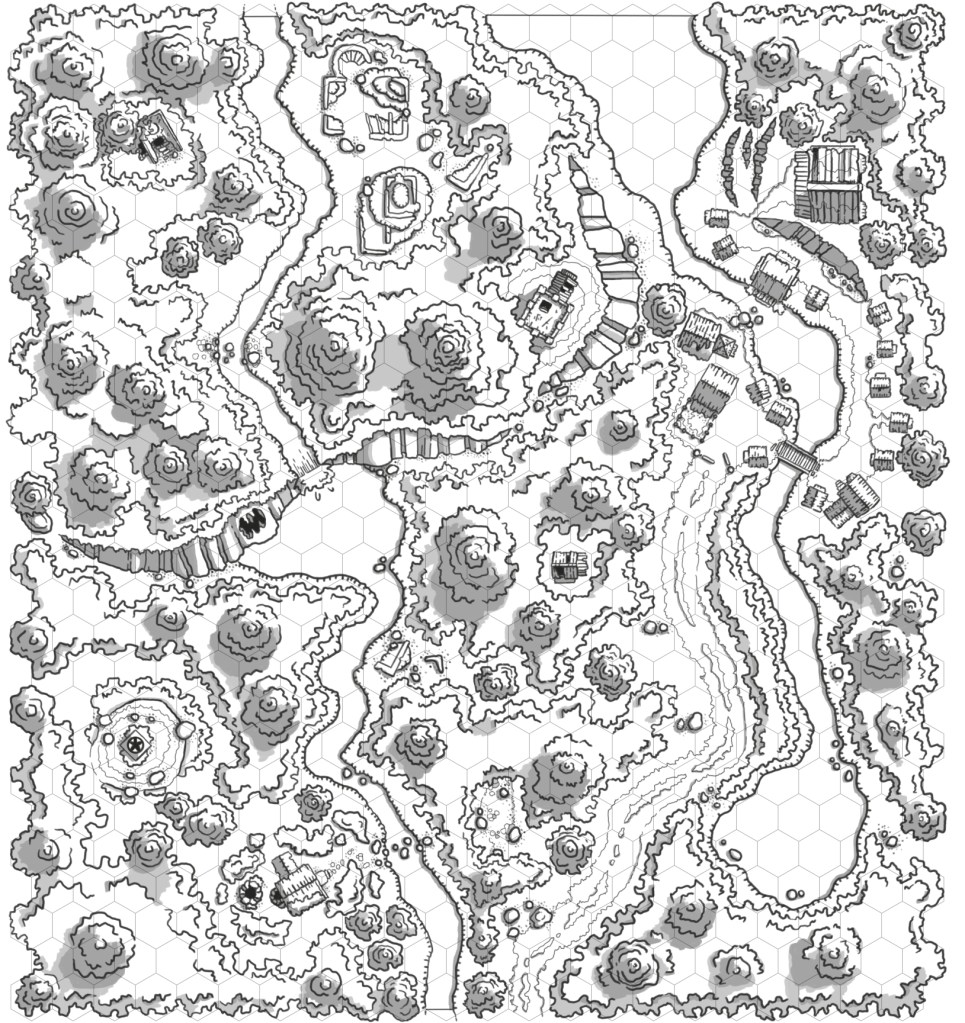
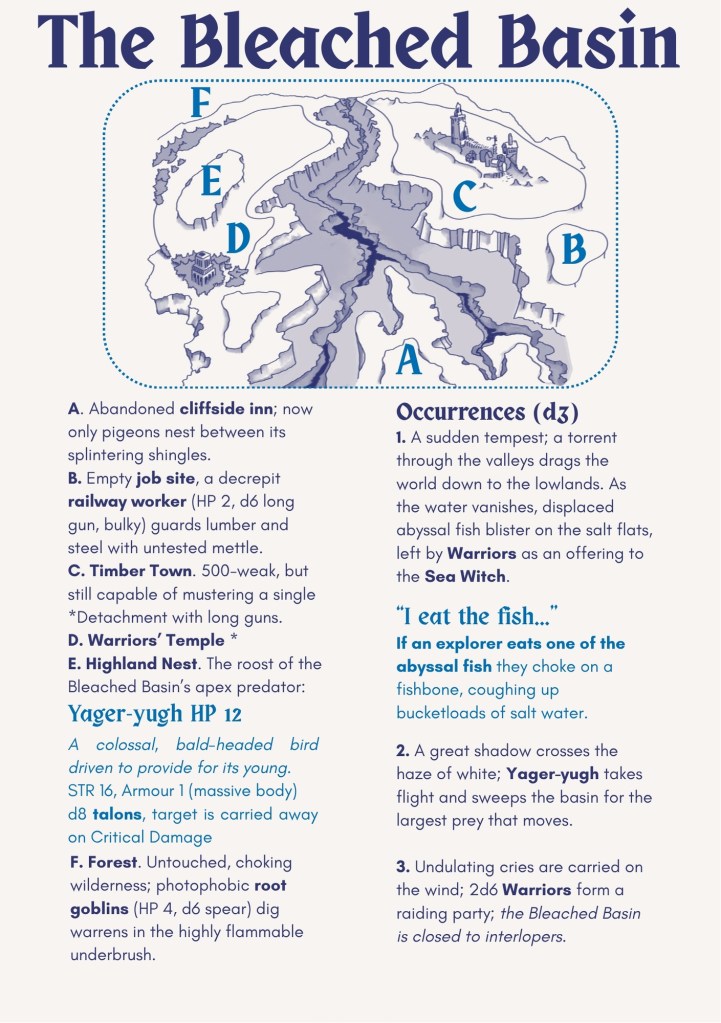
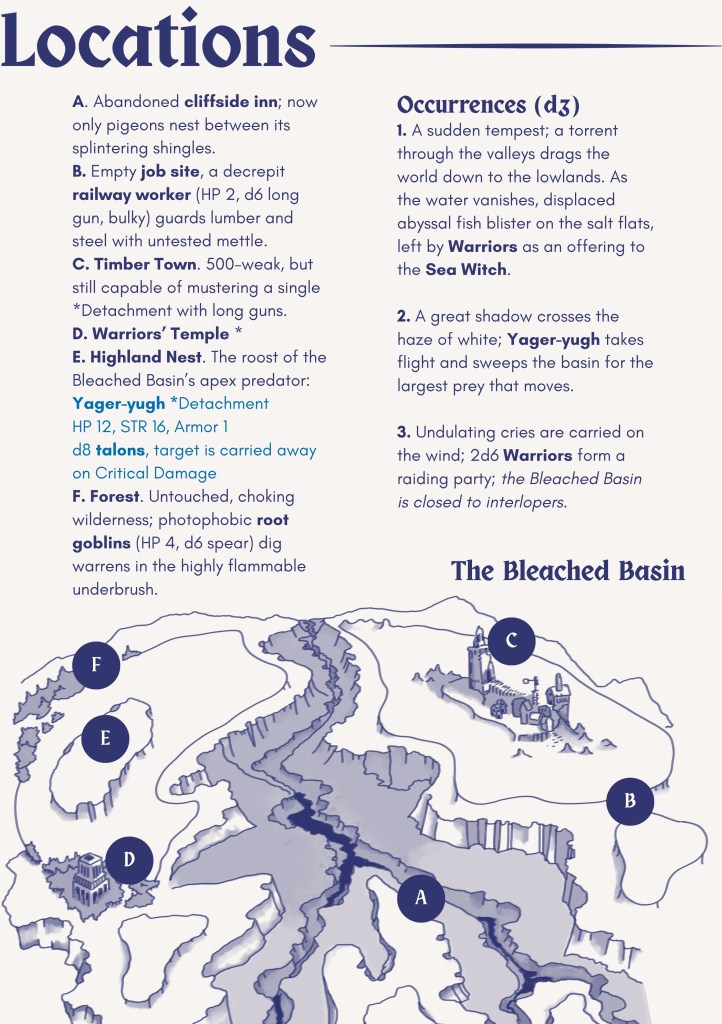
This is the first page I finished and it’s actually the closest to my original post. It was while working on the drawing of the Bleached Basin that many of my ideas calcified, while the rest fell away like brittle, grasping fingers of bleached coral. For me, I discovered, the visuals lead. Without the pressure to put my ideas into words, and with hours ahead of me to draw, think, refine, and draw again, the entire setting *develops* in my mind like a photograph darkening to reveal itself.
I’m most proud of this final page, really, because it communicates so much about the harsh reality of living in this place with very few words.
Conclusion
I’m really happy with how this adventure came out, and I’m grateful to the Appx. N Jam judges for taking a look at it. This isn’t something I would have come up with if it weren’t for the imaginative prompt I was provided with and all of the awesome inspiration I was filled with looking at last year’s submissions.
One of my favourite things about Ravenloft is its wacky worldbuilding: each Domain of Dread is a mind-prison tailored by mysterious Dark Powers to eternally torture its Darklord. Made of shadowstuff and the Darklord’s own memories, these domains are unreal yet populated by very real, trapped souls.
The most famous Darklord is Count Strahd, imprisoned in Barovia and tortured by repeated reincarnations of his beloved Tatyana. The campaign’s most horrifying reveal is that this loop repeats endlessly just to punish Strahd, regardless of the collateral damage. You are, effectively, meaningless in a cosmic struggle between an asshole and an even bigger asshole.
Art by Wizards of the Coast
Darkon stands out among the domains in Van Richten’s Guide to Ravenloft (2021) because it is on the brink of destruction. Before your campaign in Darkon even begins, the Darklord–the Lich King Azalin Rex–has already won. He escaped.
During the Hour of Ascension, Azalin vanished, leaving Darkon to dissolve into the mists. Without a Darklord to punish, the Dark Powers have no use for the domain, and the Shadowfell is reabsorbing it. As the mists fracture the land, familiar people and places simply fade from memory.
The authors write:
“Despite facing gradual annihilation, Darkon’s living population largely ignores the threat, dismissing reports of vanished regions as rumors and fearmongering.”
And this is why I can’t stop thinking about Darkon.
Art by Gladys Amy Mock
On Saturday, my city broke a 100-year temperature record. The heat, paired with 85% humidity, triggered intense nausea, headaches, and a profound sense of anxiety–and I’m a healthy 32-year-old with no respiratory conditions.
Friend-to-pedophiles and eBay billionaire Peter Thiel is planning to leave society behind for a floating, libertarian nation built for profit. Epstein-black-book-reject and son-of-an-emerald-baron Elon Musk plans to leave Earth altogether for Mars, having already become the world’s first trillionaire when SpaceX went public. Piss-bottle-enthusiast and Amazon founder Jeff Bezos has expressed a similar desire to abandon the world he helped to ruin.
While it is tempting to compare the elite billionaire class to Azalin Rex or other Darklords of Ravenloft, the reality is much more terrifying: our world is a rudderless ship drifting on the currents of capital, and no one can stop it from crashing into the rocks. The fallout of the impending climate disaster will kill more people than any historical atrocity. Despite their immense creativity, the writers at Wizards of the Coast cannot engineer a Darklord whose evil rivals the real-world systems that are set to doom us all.
Yet, one element of their worldbuilding remains hauntingly accurate: how people respond to the inevitable end. Like the citizens of Darkon, we will be forced to watch the people, places, and traditions we love disappear first from reality, and then from our collective memories–like so many souls lost to the mists. To speak of it will be dismissed as fear-mongering and rumors.
This year I’m participating in the Appendix N Jam. My prompt was Warriors of the Bleached Basin.
I spent the first hour of this game jam wondering if I should design a gladiator arena for Mausritter about a sink in an old garage filled with dangerous human junk. You know, mice fighting in a dusty dome called The Bleached Basin–sometimes the mice flood it for aquatic battles (picture it: two mice on each handle turning on the water, mice and other rodents cheering and screaming for blood, a fat cat watches from a shelf on high). As cute as that sounds, I decided it’s outside of the scope and spirit of this jam, which is supposed to reflect mid-century pulp novels.
Like with barbecue (not grilling, barbecue; another skill I’ve been trying to dial-in this summer), I’ll probably get the best results for my first ever *game ham* if I keep things as simple as possible.
Warriors of the Bleached Basin (for Cairn 2e)
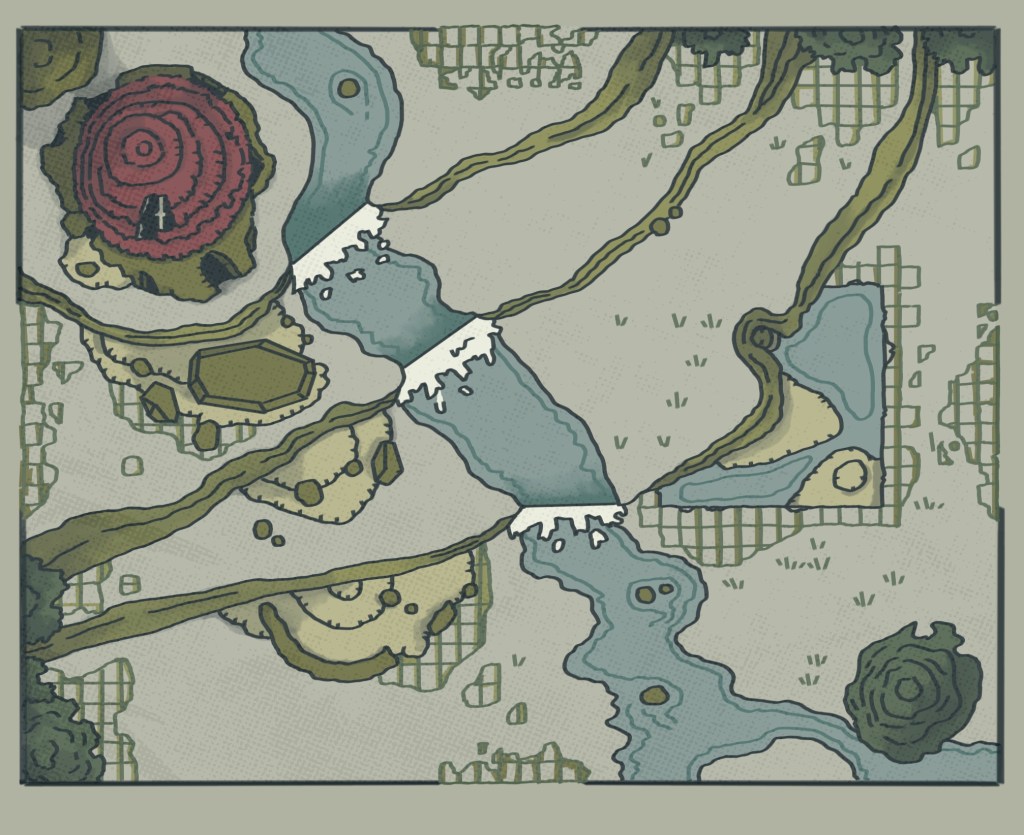
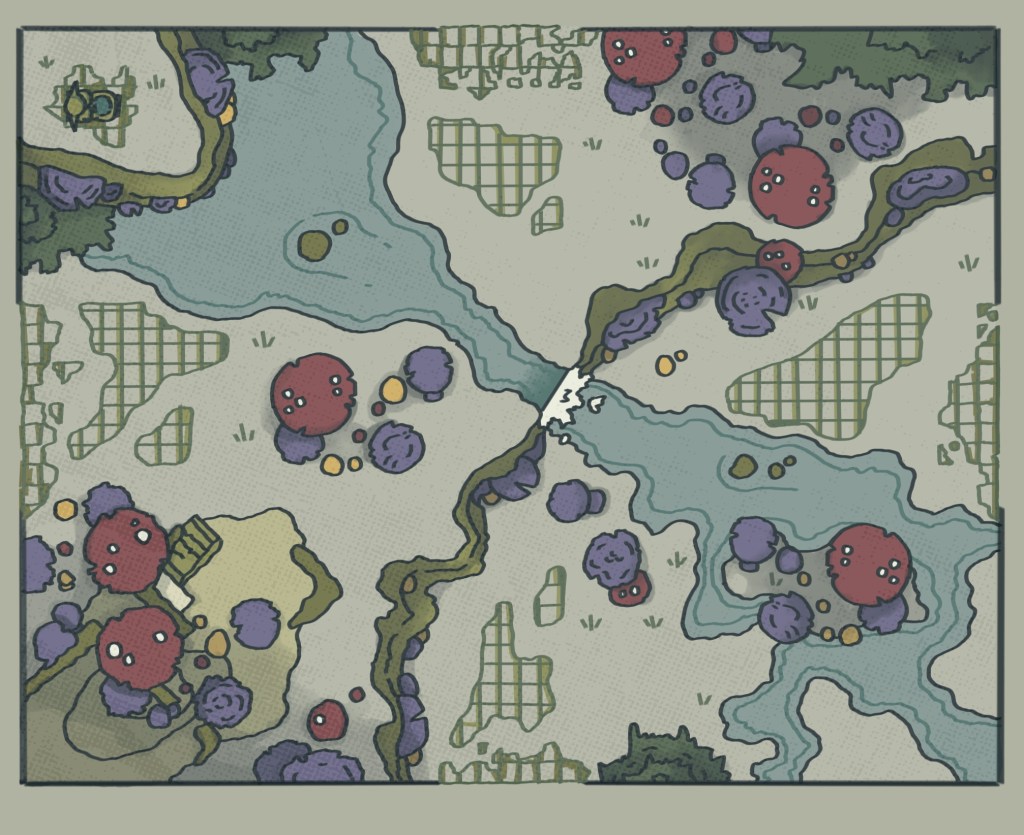
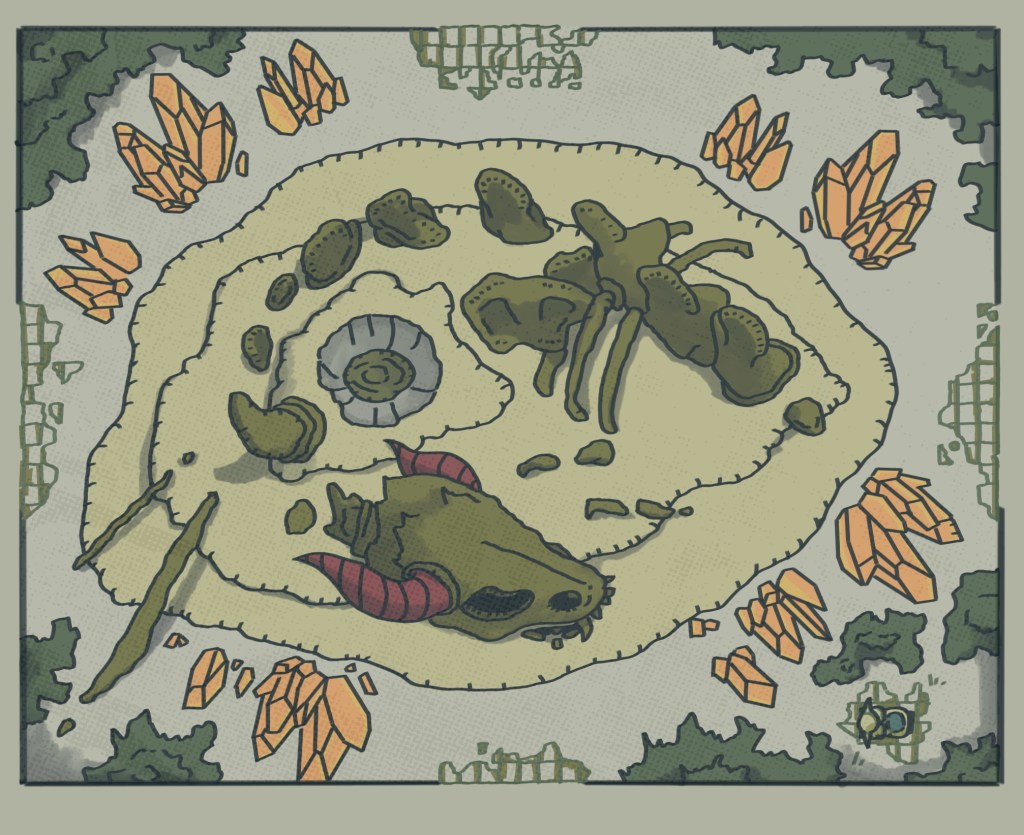
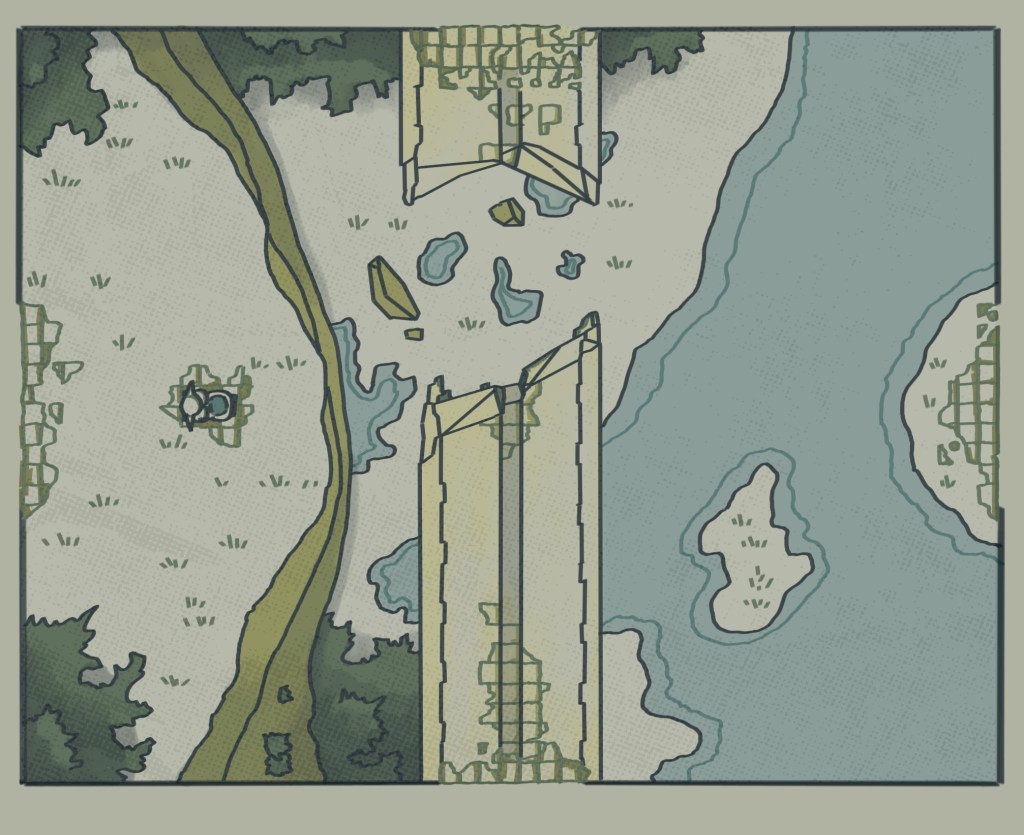
I’m picturing a science-fantasy setting in a dried up river basin. There’s a mountain, a salt-stained valley, an ancient lighthouse, and a mysterious ancient gate (it’s missing a huge piece, and it no longer functions).
Reptilians–the Warrior tribes protecting the last of the muddy water from exploitation.
The Sea Hag–Hiding in the flooded remains of her ancient lighthouse, casting desperate magics for the water to return.
The Basilisk–Slithers in the deep, dried up ravines throughout the region. A single, apex predator. Leaves a trail of petrified victims.
The Roc–Perches on the mountain top. Hunts the reptilians below.
Root Goblins–Live throughout warrens in the thick, dead brush of the ravines.
Industrialists–Pump water from below with rusted machines. Live in odd, square houses. Travelled through the gate.
Interlopers with advanced knowledge of metal working and manufacturing. Groups of four or more are a detachment.
A detachment always travels with a leader holding an heirloom boomstick (d10).
On taking Critical Damage, the industrialist’s fuel tank explodes in a fireball (d10, blast) igniting flammable objects around them.
Art by Paul Kucharyson
If I’m being honest… I’m not in love with my idea, but I’ve been sitting on it for like a week now letting it take root and at a certain point you just need to commit to *an* idea and hope you fall in love along the way.
Today I’ll be working on the map: I only have four A5 pages for the whole adventure, and I’m kind of keen on doing a cover, so I’ll need to keep it a simple map for legibility. Stay tuned.
I always listen to music when I play RPGs. There are many good reasons to use music in your games and I’m sure you’ve already heard them all so I’ll just tell you my reason: it’s fun to build playlists and imagine what kind of scenes could unfold in your setting.
I made this playlist with my Electric Bastionland setting in mind. It’s noisy as hell, but there’s a hidden structure to it if you’ll allow me to explain.
Music as Pacing
The playlist is about 3 hours long which is about how long I like to play with my friends. I don’t switch to a playlist for the game until after we’ve all had a chance to chat and catch up, eat something, etc. So the playlist only needs to last as long as we’re actually playing.
The Rising Action. Tracks 1-12 create a liminal space vibe (45 minutes). This is good for the recap, the early roleplay, the early exploration, the driving/sailing around, deciding where to go, etc.
*If you start the Players at the Balcony Cliffs and let them poke around, this music brings that staticky, echoey vibe of the collapsing structure.
The Action. Tracks 13-19 are for explosive action (33 minutes). It comes in like a jump scare. This is good for car chases, combat encounters, running from monsters, seeing something horrible happening and deciding what to do.
*Once things start to slow down you should jump ahead so the high-tension music doesn’t overstay its welcome.
The Dread. Tracks 20-23 are for when things get really bad (29 minutes). This is for when characters go down, when the odds are stacked against the Players, or when you want to reveal a monster that should inspire fear.
*Notice how if the action goes on too long, you’re going to get here anyway (fighting in Electric Bastionland should rarely be a wise choice).
The Familiar, Warped. Tracks 24-26 are for a return to safety. This is good for breaks, and for those times when the Players get away from the danger. It leads nicely into the next section.
*Go back to this section anytime your Players find a safe place to rest or have a moment to collect themselves. It should feel sort of like a Resident Evil safe room, over the length of a campaign your players might internalize this music as being a meta signal that you’re not going to surprise them (until, maybe, you do).
The Long Drive/Sail. Tracks 27-37 are for Player driven moments or low stakes exploration (45 minutes). After we’ve resolved some game-changing encounter in the middle of a session, I like to hand it over to the Players in the back half and let them explore freely so they can come up with what they want to do in the next session. It’s a rhythm that works for me.
*Not all of my sessions will have the same structure, obviously, so I might cycle through these parts of the playlist as I need to. The structure is just nice in case the music drifts into the background entirely, because the focus should be on what’s happening at the table above all.
The Credits. Tracks 38-40 are for wrapping things up (13 minutes). Here, you’re playing your characters off stage and signaling the session is wrapping up.
You can check out the playlist here. I hope you’ll dig this as much as I do.
***Shoutout to my good friend and a regular player who introduced me to many of the artists who made it onto this playlist. Love you, Zach.***
Old House. The Byron family refused to move, even when the Lab came. No one knows what happened to them, or their infamous collection of antique coins.
Art by Virginia Richards
I wrote previously about how my adventure was inspired by Kelsey Dionne’s Cursed Scroll #1 for Shadowdark RPG. Kelsey described the Gloaming with a couple of terse, evocative sentences for each location, and left room for me and my table to make it our own.
“509. Outlaw Camp. 30 bandits camp here led by Greaves Redthorne, an outcast Knight of St. Ydris. Greaves, a cunning liar, serves the marrow fiend Unduluk, who is only a few moons away from erupting from the marrow tree at the center of camp. Unduluk needs protection from the Knights of St. Ydris (1406) for now, and human flesh after its apotheosis. The bandits do not realize they serve as both.“
These four sentences served as the spark for a fiery manhunt arc, none of it written explicitly in the text of the adventure. When the party set a trap for Redthorne on the bridge outside of Marin’s Hold, the only thing I knew about the guy, really, is that he’s a cunning liar.
As Redthorne approaches the bridge to meet with my players (for plot reasons), something is off. He hasn’t seen anyone travelling to or from Marin’s Hold all day. He lets the wind wash over him, breathing in the scent of the forest. He succeeds on a WIS check (his cunning). He raises a hand, the bandits stand motionless.
My players watch from the trees–ready to ambush–as the bandits form a tight huddle around their leader. Redthorne casts shadowdance, weaving shadow stuff into an illusory version of himself who walks confidently onto the bridge with more than half of the bandits (his deception, and his willingness to sacrifice the bandits).
My players spring their trap. Their archer/fighter fires a flaming arrow at the payload of explosives strapped under the fragile bridge. All of the bandits are killed in the explosion, torn apart and scattered with the bricks into the murky river below, but Redthorne dissolves into shadow. He steps toward the flame, ready to fight like a demon to his bitter end.
It was an epic conclusion to a great arc, and while none of it was spelled out for me by Kelsey, I feel like all of it was consistent with her design, her writing, and her worldbuilding.
Page 11 of my adventure lists 6 treasure sites with one sentence descriptions for each, naming a treasure and hinting at a danger within. In an earlier blog post, I had a lot of fun expanding on the Lakeside Lodge and ended up with a Shining-esque creepy mansion full of fish ghosts.
Let’s do that again, only this time for the Old House. Maybe we can answer some questions about the eponymous Byron Family and their so-called infamous antique coins.
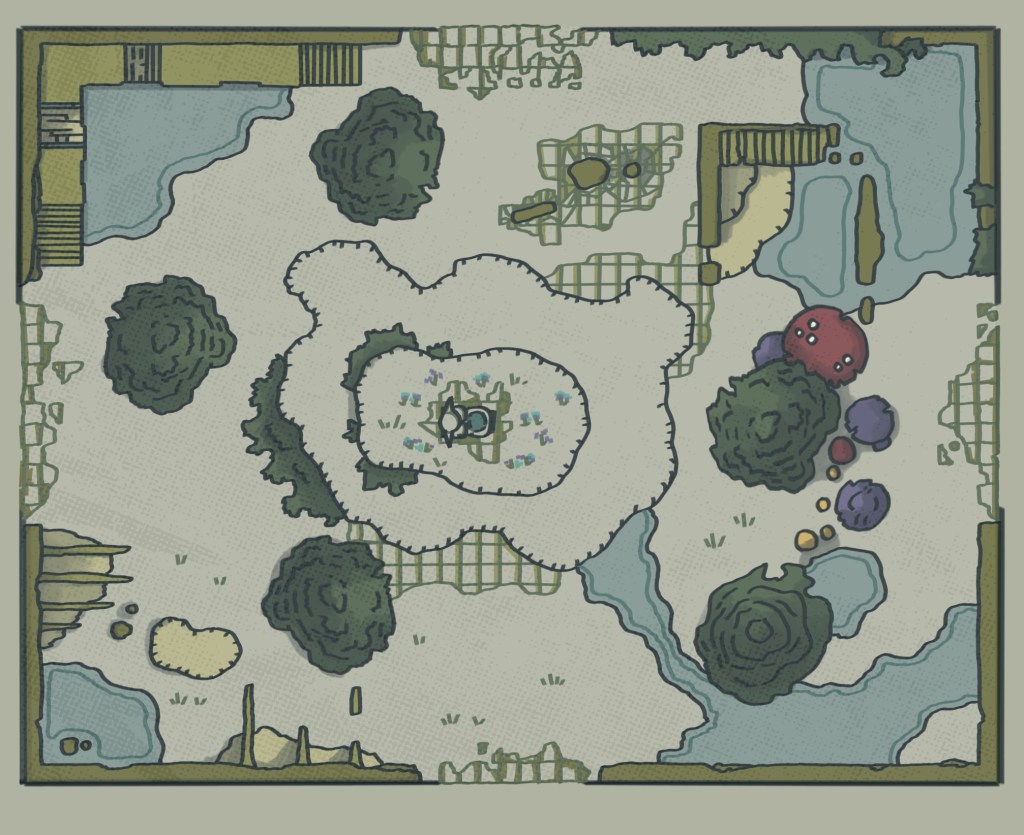
Map of the Old House
As per usual, I go to Dyson Logos. Obviously, I love drawing maps, but I’m not a machine, I can never draw all the maps I need. And I want to play tonight.
I like this map and its counterpart. The Byron’s have been gone for over fifty years and the Old House was built in a *coastal vulnerability zone* (in other words, it’s been battered by the elements). Here we can see that only the brick elements remain and a lot of the wood/plaster/ceramic has fallen away. A small wooden shack on the west side of the mansions’ ruins is home to Granny Byron.
Granny Byron HP 8 Driven to hold onto her antique coins forever and ever and ever. STR 18 Bite (d10), false teach shatter on Critical Damage (d6 Blast) Adapted. Granny Byron has held onto these coins for a long, long time. She can perform any mundane action without the use of her hands.
Antique Coins. Just a normal box of antique coins. To the right collector in Bastion, easily worth £1,500.
OLD HOUSE ENCOUNTERS Roll d6
1. Jack Byron wants you off his property. He’s tired of pesky Lab workers picking through his trash. If you know where Sophia is, he’s much more agreeable
Jack Byron HP 6 Driven to help his mother rest. Armour 1 (Breast Plate), STR 12, CHA 12 Shotgun (d8, Bulky)
“Those jackoffs at the Lab think they can take what they want, like city folk are so much smarter than us country folk. Wait a minute, where did you say you were from again?”
2. Janet Byron gardening around the ruined mansion’s exterior. She’s more welcoming of guests than her husband, but flies into a rage if anyone points out the dreadful state of her home.
Janet Byron HP 8 Driven to redeem herself in the eyes of her mother-in-law. Armour 1 (Chainmail), DEX 12, CHA 12 Rapier (d8)
“Those antique coins are all we have left. Sophia needs to take over holding them for her grandmother, it’s her duty as her father’s eldest daughter.“
3. Ricky Byron setting bear traps all throughout the property, hidden under the brush. He isn’t interested in the Players, unless they’re willing to share stories of their violent exploits.
Ricky Byron HP 4 Driven to see others in pain. CHA 8 Stinky Blade (d6), DEPRIVED on Critical Damage
“Ricky doesn’t give a shit about those coins. Ricky doesn’t give a shit about you.”
Bear Traps. Hidden under the brush, difficult to see because of all the litter and debris. Causes d6 damage and stuck for 1 Turn.
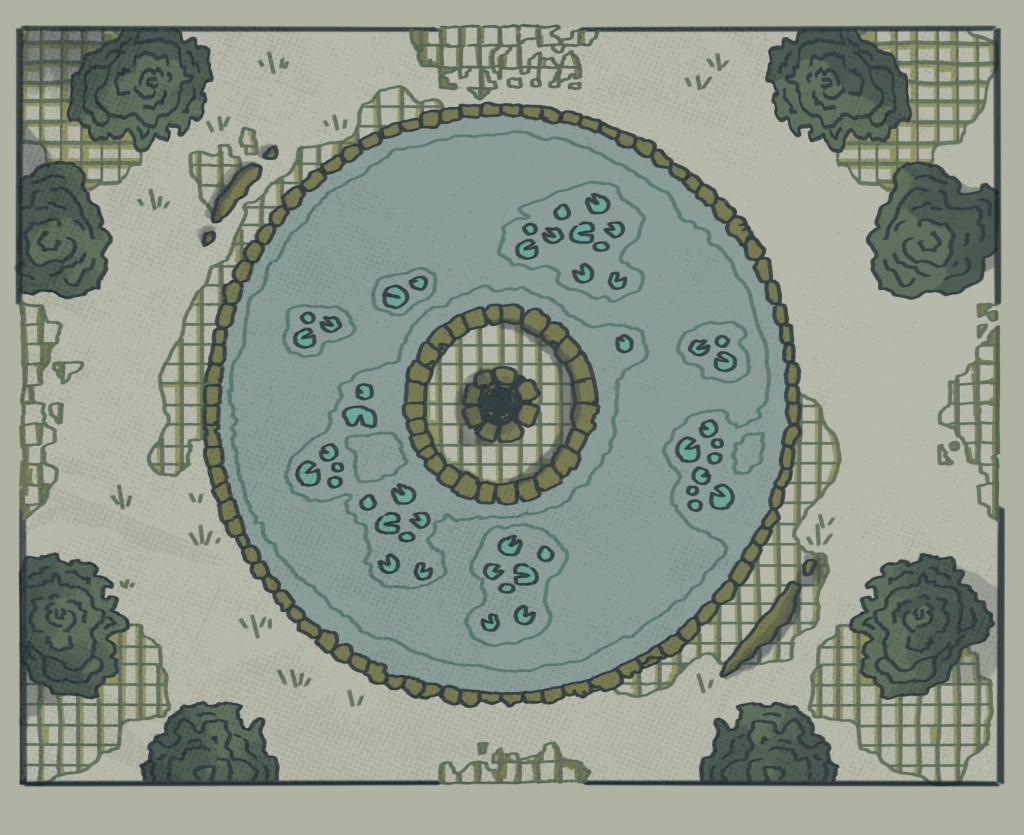

Art by Ohara Koson
4. A dozen white rabbits emerge from the lowlands to the west and dash through the property toward the road to the east. One of them stops and looks at you for a moment, as if lost in thought, before reuniting with the others.
Retter, the Original White Rabbit Driven to hide in plain sight. Armour 1 (Blue Flames), CHA 14 Moonbeam (d10), permanently blinded on Critical Damage
5. Four Field Agents in rubber hazmat suits scanning the Old House with strange machinery. They will encourage the Players to leave, for their own sake.
Field Agents HP 4 Driven to find the Original White Rabbit. Armour 1 (Hazmat Suit) Snare Pole (d8, Bulky) ensnared on Critical Damage or Concealed Pistol (d6)
“I can’t believe you’d be here without the proper protection… I guess you people will do anything for a quick buck.”
6. Three Ferrymen looking to steal those antique coins they heard about. One of them managed to pry the box of coins from Granny’s hands, but she’s relentless. She got them back.
Ferryman HP 3 Driven to find some treasure and get back to the Lighthouse. CHA 12 Pistol (d6) or Switchblade (d6)
Final Thoughts
So, here we have a potential standoff at the Old House. Everybody has conflicting drives, and the verticality of the map makes it a potentially interesting stand off (if it comes to that).
I wouldn’t describe the entire location in a lot of detail for the Players, just print a blank map and put it in front of them.
Print one for yourself and write directly on the map: decide where a few bear traps are, put something useful but inexpensive in the treasure chest on the upper levels. I would put one of the Coastal Oddities from Page 37 in there, if it were me.
The chest requires 7 antique coins be inserted into the lock-slot to open (lessening the total value of the coins to £1,200).
For more hazards and obstacles, don’t forget to look at “34 Good Traps” on Page 304 of Electric Bastionland. For this map, I would choose the following:
(6) “A column of light. When a being enters they are frozen, and an evil duplicate of them is conjured. The victim is only freed when the duplicate is killed.” Put this on on the southern altar.
(21) “Rope bridge primed to split in the middle when the majority of the crossing weight has passed the midpoint. The characters can grab their half of the bridge and climb back up easily enough.” The last bit of ruins connecting the upper levels.
(13) “Glossy, friction-less floor and spiked walls.” Seems like something Ricky Byron would do. On the top floor of the southern structure, he’s poured motor oil all over the floor and fixed sharp metal and glass to the remains of the walls. On top of that, there’s a risk of falling in the southeastern corner of the room. Ricky will try to trick the Players into going up there if he can.
This month, I’m reading Dead Astronauts by Jeff VanderMeer. It’s the sequel to Borne—a novel I absolutely adore for its refusal to hold the reader’s hand. VanderMeer respects the reader; he drops a disturbing piece of worldbuilding, moves on, and trusts you to sit with the implications. But Dead Astronauts feels less like a traditional narrative and more like a fever dream. The prose is heady, the plot moves with a surreal, hallucinatory cadence, and while I love every second of it, I’m frequently left wondering if I’m too high or not high enough to really get it.
In a novel, that kind of beautiful disorientation is part of the joy. If I lose my footing, I can slow down, re-read a passage, or parse the text at my own pace. But a ttrpg is a different beast entirely. A tabletop plot is a living, ephemeral thing; it happens in real-time, exists only in the moment, and can’t be flipped back a few pages when a player loses the thread.
This leaves designers with a fascinating challenge: how do we build surreal, vibe-heavy worlds while keeping our players grounded enough to actually navigate the fiction? It’s a precarious tightrope walk, but it’s a balancing act that In a Petal Unlimited absolutely nails.
Art by Apollo (@poliaths)
In a Petal Unlimited is a 23 page adventure for Cairn (although designed for Wyrm, which I have not played). Words and interior art are by giant robot tackler. The cover illustration is by Apollo (@poliaths).
“At the sea’s center, a blocky spire lunges upward, tall as a lighthouse and twice as thick. Fresh vines form a lattice on its surface. Large birds flit to and fro – a vertical ecosystem… Every hour, on the hour, a single wave pulses from the spire.”
The Surreal, Grounded
Among the adventure’s cited inspirations is VanderMeer’s Annihilation. In that novel, Ghost Bird/the Biologist is driven into a hallucinatory, deeply personal nightmare of ecological terror. In a Petal Unlimited riffs on those same visual themes while deftly avoiding the trap of becoming an unplayable, avant-garde slog. It stays grounded by giving the Warden concrete tools. The NPCs are sharply sculpted, allowing you to easily convey the vague sense of *intimacy* the locals feel toward their strange environment. The adventure offers a brilliant structural hook: the players are following the trail of a missing expedition. This is exactly how I opted to run the Iron Coral; *rescue* the missing explorers is a much better verb than *experience* the weirdness.
From the Tavern to the Spire
The adventure comes out swinging with one of the best ~meet in a tavern~ setups I have ever seen in a one-shot. The tavern here is the Last Vespers, a rudderless barge guided gently along by swarming minnows. I immediately wanted to run this adventure based on the concept of the Ship alone. The Ship acts as a launchpad for fantastic hooks–most notably Bill Billions and his experimental flying machine. I deeply appreciate that the flying machine offers a fun, open-ended escalation that can completely upend how the party approaches the Spire. I would have so much fun embodying Mr. Billions.
Once the players begin their ascent, the module introduces a falling mechanic that made me incredibly jealous as a designer. I can instantly picture the spongy, gentle fall into the black grass, and the elegant way momentum actually makes the landing worse for the player. It’s the exact kind of physics-based hazard that is effortless to make a ruling on because you can vividly see it in your mind’s eye.
The Spire encounters themselves all feel like they organically belong to the vertical ecosystem, presenting highly believable hazards for climbers. The believability is reinforced as the ecosystem dynamically shifts across Morning, Noon, and Evening watches.
My personal favourite is Noon: the oppressive heat drives desperate squirrels to frantically tear into the characters’ waterskins. Perfect.
The Delve
When the party transitions into the dungeon encounters, the writing remains sharp, pointed, and clearly remembers to have fun with the language. The environmental events are the absolute standout here. As I was reading, I found myself wondering: what happens when the tower pulses while the PCs are inside? I wasn’t disappointed by the answer.
A personal favourite of mine is Room 6, the Phase Error encounter. It features an NPC whose age flickers every time you blink, sitting over a chest that duplicates into unfocused images. It is exactly my kind of encounter–deeply weird, interactive visuals. The environmental *weirdness* adds a literal justification for a combat encounter with multiple phases, as the NPC splits into copies of herself on Critical Damage. It’s the kind of out-of-the-frying-pan action writing that I prefer over a traditional slugfest.
Shape-Shifting Conclusions
The dungeon’s surrealism reaches its peak in Area 12 where the players encounter a massive, tumorous heart, forcing out a single, torturous beat each hour. I won’t spoil the adventure, but the designer beautifully gamifies the climax by providing concrete mutation tables based on the party’s moral choices.
Ultimately, the conclusions offered at the end of the adventure maintain the exact same grounded approach: the consequences of the players’ actions are beautifully and heavily described, but refreshingly, they are not over-explained. It leaves the mystery intact, trusting the Warden and the players to sit with the implications–much like VanderMeer would do.
Ever since I ran my Ravenloft campaign using Shadowdark RPG, I’ve been fantasizing about adapting the module for Mausritter, replacing the eponymous Count with a similarly tragic vampire bat. I don’t know if I’ll ever get a chance to run that campaign, but if I do this is the map I would use:
1. Old Windmill. Village of 100 mice on the flagstone floor of a long-abandoned windmill. They fear the reclusive, immortal Count who lives in the rafters above the millstone. None are welcome upstairs an invitation.
The Count HP 12 STR 14, DEX 12, WIL 16, Armour 1 Bite (d10), target is drained of all blood on Critical Damage and rises as an undead thrall of the Count. *Knows the following spells: Fireball, Darkness, Fear (Mausritter page 13) *Can fly 2x normal speed. *The Count regenerates 6 HP each time he bites a target with blood. *If he is killed, he becomes a cloud of mist that retreats to his roost in the rafters to regenerate. He can only be truly killed if his roost is destroyed.
2. Flowerbed. An overgrown, mist-addled path cuts through the weeds and flowers to the graveyard north of the Windmill.
3. Handcart. Tipped over and overgrown; sodden human debris sinks into the mud. Among the cloth, glass, and metal are dozens of human teeth.
4. Overgrown Path. Deep gouges in the mud, gnarled roots, grasping, claw-like branches.
5. Fence Posts. Overgrown and rotted. A twisting path through the mud rises to the windmill on the hill.
6. Standing Stones. Ancient stark-white stone carved with arcane symbols.
7. Ravine. Where the forest meets the hills, a narrow ravine is home to a ghastly order of vengeful, knightly lizards.
8. Cemetery. Crooked obelisks and a shattered mausoleum. Inside, a stone sarcophagus is shattered. The human remains within are fanged and steaked with cursed wood (here lies the source of the Count’s curse).
9. Gallows. At the crossroads, a human structure collapses into the brush.
10. Signpost/Ditch. Overgrown wood engraved with human symbols. A ditch beneath the trail is home to frightened badger (unable to escape the mists).
11. Lakeshore. Misty and still. An immortal, amber catfish offers Dark Boons for those who vow to slay the Count.
12. Fallen Tree. Two dozen colourfully-dressed squirrels camp here. They are the only creatures permitted to freely leave the Count’s domain, but they prefer to stay where they know they are protected.
13. Reed Forest/Lily Pads. The ruins of a frog village who’s burgomaster tried to defy the Count.
14. Marshes. Bobbing witch lights and faeries can be seen here at night, where the river meets the lake.
15. Covered Bridge. Roost of the Count’s vampire bat spawn.
16.Evergreens. In these twin towers, an owl sorcery nurses the wounds from his near-fatal encounter with the Count. His defeat has turned him to madness.
17. Waterfalls. Cascading waterfalls, a treacherous climb. Home of a territorial mountain goat.
18. Wolf Cave. The Count’s most powerful ally is a mangey wolf who worships him as a God.
19. Old Raven’s Tree. A hollowed tree and the home of an insane raven matriarch. She believes herself the mother of the Count, despite all evidence of the contrary. She infuses mousetraps with the souls of murderous rodents to make an army of wicked constructs.
Last year, a friend introduced our group to Brindlewood Bay. I was immediately struck by its near-perfect mystery system. Over six sessions, we told a largely player-driven, truly resonant story about facing loss. Now, I’m running Public Access for some of the same group. Three sessions into a planned year of play, having seen the mechanics from both sides of the screen, I have thoughts.
Art by the Gauntlet
As a player, it took a moment to grasp the game’s open use of modular clues. The designer makes no attempt to retroactively make the clues “real”—that’s the players’ job. They solve the mystery by being good storytellers with the provided prompts.
For example, if my character finds “a series of numbers,” asking “What are the numbers?” is the wrong approach. The numbers mean nothing on their own; they need context.
As a Game Master, this wasn’t a novel concept. I’ve been a fan of Sly Flourish’s The Eight Steps of the Lazy DM since I started the hobby. It boils down to keeping prep modular so you can be flexible and responsive. The eight steps are the raw ingredients you bring to cook with, but the cooking happens at the table.
One essential ingredient I always use is secrets and clues: modular facts about the situation, plot, characters, or setting. I don’t plan how the players will discover them, but I’m ready to dish out information when they investigate.
The major difference between running D&D with secrets and clues versus running Public Access is that, with the latter, even I don’t know what’s going on—I’m just dishing out the clues.
I have finally found a game so well-designed I can barely prep for it.
Art by the Gauntlet
I was surprised yesterday to hear Sly Flourish on the Lazy RPG Talk Show critique the Daggerheart adventure, The Wish Thief, and get tripped up on this mystery mechanic.
“I don’t know what clues to reveal if I don’t know who it is,” he said. “The secret and clue is still a specific thing that leads a specific way.”
I’ve never used secrets and clues that way; I’ve always improvised to align with the players’ interpretations. I thought that was how they worked!
While Daggerheart isn’t for me, I was impressed the new adventure used this mechanic, though I agree it fumbles the outcome. In the Wish Thief, whether the players solve the mystery or not, the villain escapes to trigger a chase scene. Mike rightly criticizes this railroading, but culminating a mystery in a tense scene dependent on the players’ success is a great concept.
In Brindlewood Bay, players roll to test their theory. Depending on the roll and the depth of their investigation, they may have a chance to stop the villain. If they didn’t find many clues and roll a mid-tier result, the villain slipping away makes sense. Cue the chase. This feels much better, ensuring the players’ choices and efforts actually matter.