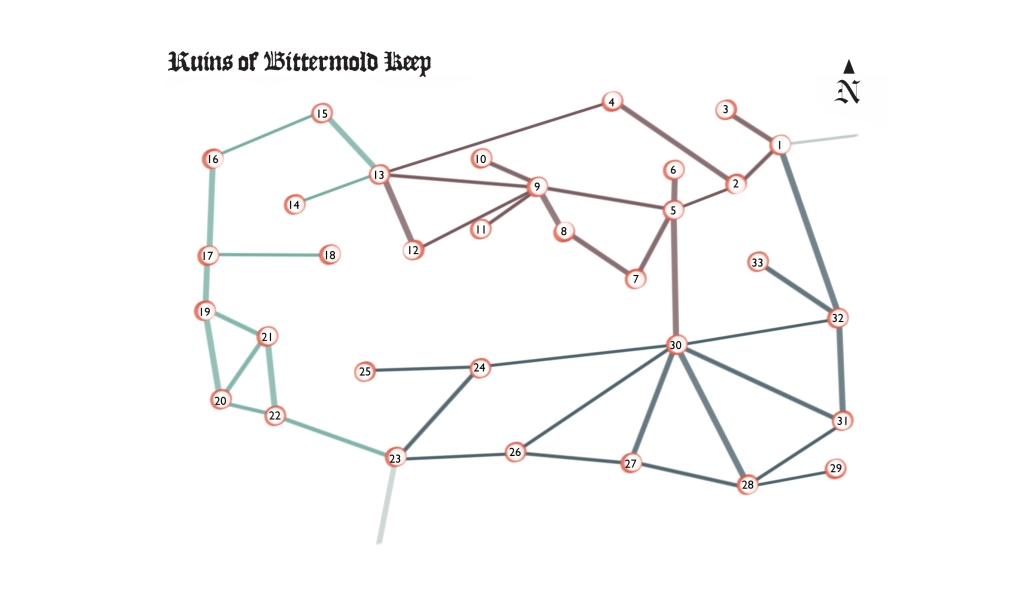
A couple of weeks from now I’ll be running the Hideous Halls of Mugulblub by Kelsey Dionne for my Open Table (see: The Alexandrian). This dungeon will introduce players to the Gloaming and launch a short nine-session campaign.
I love poring over hand-drawn, thoughtfully detailed maps like the one Kelsey drew for this adventure; the old-school, graph paper, Dyson Logos vibe is beautiful in its own right and very popular for good reason. Still, I’ve always struggled to turn my nacho-stained two-dimensional map into a living, three-dimensional space players can immerse themselves in.
“That’s a lot of doors…”
– Dwarf Fighter entering Death House for the first time
For the last year or more, my solution was to just give my players a copy of the map, often early in the adventure as a reward for discovery, but sometimes from the start with no in-universe explanation other than “this is what y’all can see.” I’ve never regretted this decision, but I’ve often wondered if there isn’t a better way to condense a dungeon to its most essential decisions while preserving the core fantasy of stumbling around in absolute darkness.
After reading and playing a little bit of Mythic Bastionland this summer I was inspired to take a second look at designer Chris McDowall’s previous masterpiece, Electric Bastionland. As a book, I love my copy of Electric Bastionland, but I’ll admit even after a couple of years of owning it I haven’t actually played it earnest, usually preferring to run pre-published adventures using its foundational rule set, Into the Odd.
“The exact geography of Bastion’s streets is less important than the main routes between key points.”
– Chris McDowall, Electric Bastionland
This time, however, something about the simplicity of McDowall’s borough rules helped me understand intuitively how I could run a dungeon like Bittermold Keep as a series of interconnected routes and key points, focusing on decisions and movement, rather than strict three-dimensional understanding.
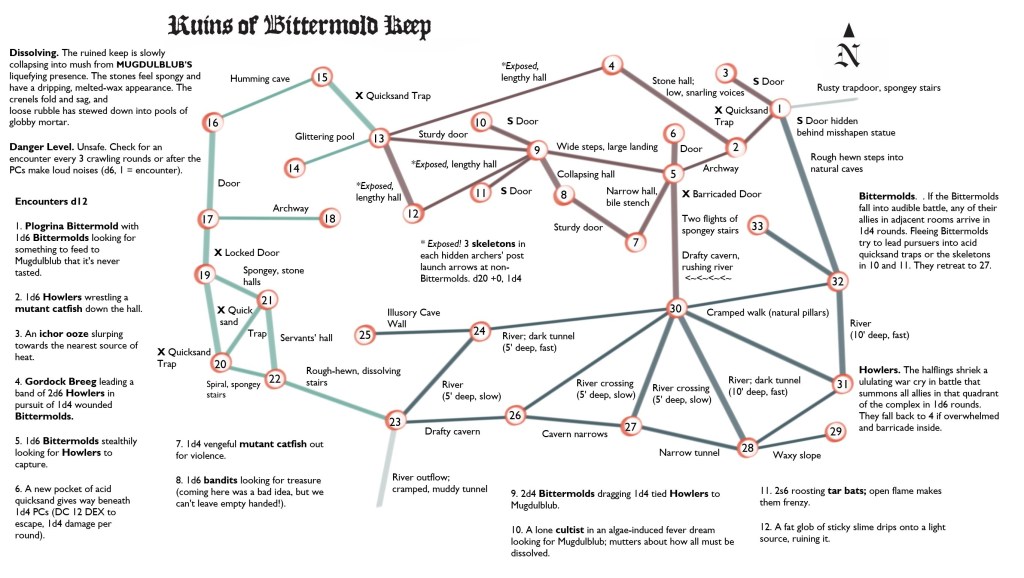
The goal was to fit as much of my notes directly onto the map as I can and use the physical zine at the table to describe each key point. The routes need to be different enough that there is a meaningful decision to make at each key location.
We’ll see how it goes.
 Bath Imaginable
Leave a comment